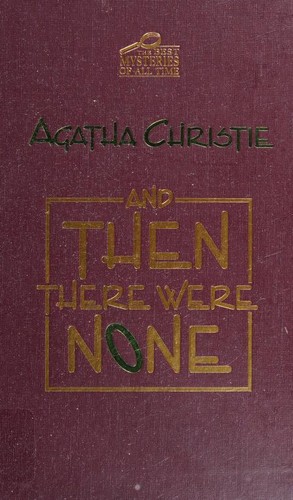
And Then There Were None Comprehension Questions & Reading Journal
4.3 out of 5, (181 ratings on Open Library)
And Then There Were None has 16 chapters · 222 pages
A US edition was released in January 1940 with the title And Then There Were None, which is taken from the last five words of the song.
Free, no sign-up. Customise to reword questions or add your reader’s name.
Inside the journal: 16 chapter pages, one question each · 3 example answers · a cover for your reader’s name
Chapter by chapter Each question is about its own chapter.
What do we learn about the different guests as they travel to Soldier Island, and what details make the island seem mysterious?See all 16 questions ↓
About the book
A US edition was released in January 1940 with the title And Then There Were None, which is taken from the last five words of the song. All successive American reprints and adaptations use that title, except for the Pocket Books paperbacks published between 1964 and 1986, which appeared under the title Ten Little Indians. UK editions continued to use the original title until the current definitive title appeared with a reprint of the 1963 Fontana Paperback in 1985.
Buy the book on Amazon ↗ (affiliate link)
And Then There Were None questions by chapter
We know this book well. Every question asks about something that happens in its chapter, a moment, a choice or a character, without giving away what comes next. One question per chapter, across all 16 chapters, and every one is editable before you print. The example answers under 3 of the chapters are the ones printed at the front of the booklet.
-
Chapter 1
What do we learn about the different guests as they travel to Soldier Island, and what details make the island seem mysterious?
-
Chapter 2
When the guests arrive at the house, what clues show that something unusual is happening?
-
Chapter 3
How do the guests react when the voice accuses each of them of a past crime, and what do their reactions show about their characters?
-
Chapter 4
What prediction can you make after the first death, and what evidence from the chapter supports your idea?
-
Chapter 5
Why do you think the nursery rhyme is important to the story, and how does it add to the feeling of suspense?
Example answer: I think the nursery rhyme is important because it gives a pattern for what is happening on the island. Each time something in the rhyme connects to a death, it makes the guests and the reader feel more worried. It also makes the mystery feel planned instead of random. I felt suspense because I wanted to know if the next line of the rhyme would come true.
-
Chapter 6
Choose one character who seems especially nervous or suspicious. What does the character do or say that makes you think this?
-
Chapter 7
How does the setting of Soldier Island affect the characters’ choices and feelings in this chapter?
-
Chapter 8
What does the word “suspicion” mean in this part of the story, and how does suspicion change the way the guests treat each other?
-
Chapter 9
Do you think the characters are working together well, or are they making the danger worse? Explain your opinion with examples.
Example answer: I do not think the characters are working together very well. They try to make plans, but they also keep blaming and doubting each other. Their fear makes it hard for them to trust anyone, even when teamwork might help them survive. I think their suspicion makes the danger worse because they cannot stay calm or united.
-
Chapter 10
How does the author build suspense as the number of people on the island grows smaller?
-
Chapter 11
What does Vera’s behavior in this chapter reveal about her fears, memories, or guilt?
-
Chapter 12
If you were one of the remaining characters, what plan would you make to stay safe, and why?
-
Chapter 13
What theme, or big lesson, is starting to appear about guilt and justice? Use events from the story to explain your thinking.
-
Chapter 14
How do the characters’ feelings change as they realize there may be no escape from the island?
-
Chapter 15
Which moment in this chapter surprised you the most, and why did it change how you understood the mystery?
-
Chapter 16
After learning the solution, how did the ending change your view of the clues from earlier chapters?
Example answer: After I learned the solution, I looked at the earlier clues in a new way. Some details that seemed small before were actually important. I realized the author was hiding the answer in plain sight, but I did not notice because there were so many suspects. The ending made me want to reread parts of the book to see what I missed.
More ready-made journals
-
 The Truth About Stacey
-
 The Unlikely Tale of Chase and Finnegan
-
 The Unteachables
-
 The Westing Game
-
 The Wild Robot
-
 The Wild Robot Escapes
How to use this And Then There Were None reading journal
At home, as a discussion guide
After each chapter your reader writes a few lines on that chapter’s question. Read the answer together at bedtime: it shows what they understood and gives you something real to talk about, without a quiz.
In class, as a novel study
Print a class set (booklets fold from plain letter paper) and use one question per chapter as the reading-response or literature-circle prompt. The example answers at the front show what a full answer looks like.
Homeschool
One booklet covers the whole book, 16 chapters, so it doubles as the reading log for And Then There Were None. Reword any question before printing to match your reader.
Printing
The booklet PDF prints on ordinary 8.5 × 11 paper: print double-sided (flip on the short edge) at 100%, fold the stack in half and staple on the fold. There is also a one-page-per-sheet PDF and A5 binder pages.
Where the questions come from
Each question is about its own chapter. We know this book well. Every question asks about something that happens in its chapter, a moment, a choice or a character, without giving away what comes next. The questions were drafted with AI from what is known about the book and checked before publishing; every one is editable before you print.