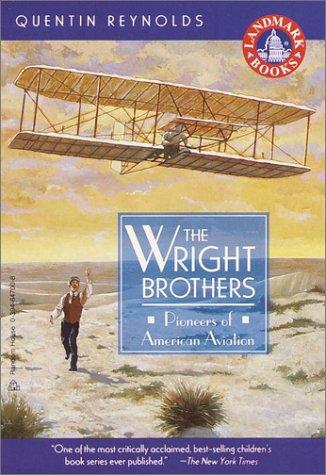
The Wright Brothers, pioneers of American aviation Comprehension Questions & Reading Journal
The Wright Brothers, pioneers of American aviation has 16 chapters · 183 pages
Book 10 of the Landmark books series
Free, no sign-up. Customise to reword questions or add your reader’s name.
Inside the journal: 16 chapter pages, one question each · 3 example answers · a cover for your reader’s name
Written for this book Questions about this story, good after any chapter.
Based on what you have read so far, what goal matters most to Wilbur and Orville Wright? Explain how you can tell.See all 16 questions ↓
About the book
A biography of the two brothers from Dayton, Ohio, who built and flew the first airplane.
Buy the book on Amazon ↗ (affiliate link)
The Wright Brothers, pioneers of American aviation questions by chapter
We know the book, its characters, setting and story, but not what happens in each chapter. So every question is written for this book, and any of them works wherever your reader has just stopped. One question per chapter, across all 16 chapters, and every one is editable before you print. The example answers under 3 of the chapters are the ones printed at the front of the booklet.
-
Chapter 1
Based on what you have read so far, what goal matters most to Wilbur and Orville Wright? Explain how you can tell.
-
Chapter 2
What have you noticed so far about how Wilbur and Orville are alike or different? Use a detail from your reading to describe each brother.
-
Chapter 3
Choose a place described in your reading so far. How does that place affect the Wright brothers' lives, work, or plans?
-
Chapter 4
What do you predict Wilbur or Orville will try next? Use something you have already read to explain your prediction.
Example answer: I predict the brothers will test an idea and then look for ways to improve it. Their interest in figuring out flight makes me think they will keep asking questions. I do not think they will expect every idea to work right away. If a test does not work, I think they will use what they learned to plan another try.
-
Chapter 5
Find a word in your reading that is new or interesting to you. What do you think it means, and how do the nearby sentences help you understand it?
-
Chapter 6
How does the Wright brothers' story so far show the value of asking questions? Describe a detail that shows curiosity.
-
Chapter 7
Describe a problem someone faces in the book so far. What does that person do about it, and what does the response help you understand?
-
Chapter 8
Besides Wilbur and Orville, which person has stood out to you in your reading so far? Explain how that person affects the brothers or helps you understand their lives.
-
Chapter 9
If you could ask one of the Wright brothers a question about what you have read so far, what would you ask? Explain why you want to know the answer.
-
Chapter 10
Which seems more important in the Wright brothers' story so far: small steps or big ideas? Give a reason and connect it to your reading.
Example answer: I think small steps are more important, even though the brothers need a big idea to get started. Wanting to fly gives them a goal, but wanting something is not the same as knowing how to do it. Their efforts to understand flight show me why learning little things matters. I think a big idea becomes useful when people are willing to work on its small parts.
-
Chapter 11
Choose a moment from your reading so far that helps you understand how Wilbur or Orville feels. What clues reveal that feeling, even if the author does not name it?
-
Chapter 12
How does something in the Wright brothers' lives so far connect to a time when you were learning a difficult skill? Explain one similarity and one difference.
-
Chapter 13
What detail in your reading so far helps you picture the time when Wilbur and Orville lived? Explain how that detail makes their world different from or similar to yours.
-
Chapter 14
What lesson about working with others can you learn from Wilbur and Orville so far? Support your idea with something you have read.
Example answer: I think the brothers show that sharing a goal can help people work together. Wilbur and Orville are both interested in flight, so they have a reason to listen to each other's ideas. I would rather have a partner help me think through a hard problem than do everything alone. Their partnership reminds me that working together means sharing the thinking as well as the jobs.
-
Chapter 15
What question about the Wright brothers' lives or their interest in flight do you hope the book will answer next? Explain why that question matters to you.
-
Chapter 16
Looking back over your reading so far, what has helped you understand the Wright brothers better? Explain how a detail changed or added to your first impression of them.
Discussion questions for after The Wright Brothers, pioneers of American aviation
Bigger questions for when the book is finished, each printed on its own ruled page at the end of the booklet.
- How did Wilbur and Orville grow or change as they worked toward their goals? Write about their earlier lives and their later experiences, using details from across the book to explain what helped shape them.
- What is the most important lesson this book teaches about inventing something new? Explain your answer with several examples from the Wright brothers' lives, and discuss how that lesson could help someone facing a difficult challenge today.
More ready-made journals
-
 The Sherlock Society
-
 The Swifts: A Garden of Vipers
-
 The Tale of Despereaux
-
 The Trouble with Heroes
-
 The Truth About Stacey
-
 The Unlikely Tale of Chase and Finnegan
How to use this The Wright Brothers, pioneers of American aviation reading journal
At home, as a discussion guide
After each chapter your reader writes a few lines on that chapter’s question. Read the answer together at bedtime: it shows what they understood and gives you something real to talk about, without a quiz.
In class, as a novel study
Print a class set (booklets fold from plain letter paper) and use one question per chapter as the reading-response or literature-circle prompt. The example answers at the front show what a full answer looks like.
Homeschool
One booklet covers the whole book, 16 chapters, so it doubles as the reading log for The Wright Brothers, pioneers of American aviation. Reword any question before printing to match your reader.
Printing
The booklet PDF prints on ordinary 8.5 × 11 paper: print double-sided (flip on the short edge) at 100%, fold the stack in half and staple on the fold. There is also a one-page-per-sheet PDF and A5 binder pages.
Where the questions come from
Questions about this story, good after any chapter. We know the book, its characters, setting and story, but not what happens in each chapter. So every question is written for this book, and any of them works wherever your reader has just stopped. The questions were drafted with AI from what is known about the book and checked before publishing; every one is editable before you print.