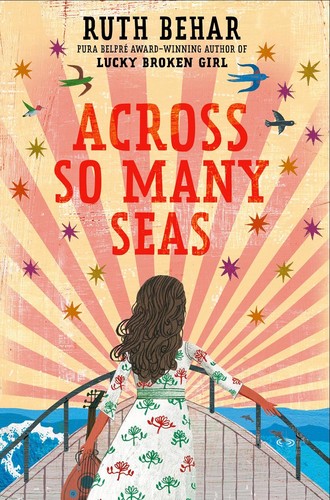
Across So Many Seas Comprehension Questions & Reading Journal
Across So Many Seas has 40 chapters · Grades 5–7 · 272 pages
Free, no sign-up. Customise to reword questions or add your reader’s name.
Inside the journal: 40 chapter pages, one question each · 3 example answers · a cover for your reader’s name
Open-ended Thought-provoking questions for any chapter book.
What is the most important thing that happened in this chapter, and how does it affect Benvenida, Reina, Alegra, Paloma, or another character so far?See all 40 questions ↓
About the book
In 1492, during the Spanish Inquisition, Benvenida and her family are banished from Spain for being Jewish, and must flee the country or be killed. They journey by foot and by sea, eventually settling in Istanbul.
Buy the book on Amazon ↗ (affiliate link)
Across So Many Seas questions by chapter
We don’t know this book well enough to ask about its story, so these are open-ended prompts that get a reader thinking about the chapter they just finished: what happened, who changed, what they would do. One question per chapter, across all 40 chapters, and every one is editable before you print. The example answers under 3 of the chapters are the ones printed at the front of the booklet.
-
Chapter 1
What is the most important thing that happened in this chapter, and how does it affect Benvenida, Reina, Alegra, Paloma, or another character so far?
-
Chapter 2
How does the time period in this chapter, such as 1492 Spain, 1920s Turkey, 1960s Cuba, or a later setting, shape the choices a character can make?
-
Chapter 3
What does the narrator of this chapter want most right now, and what details show you that?
-
Chapter 4
Which moment in this chapter helped you understand the family's Jewish or Sephardic heritage better? Explain what you learned.
-
Chapter 5
Choose one word or phrase from this chapter that felt important, unfamiliar, or powerful. What do you think it means, and why does it matter here?
-
Chapter 6
How does this chapter show the difference between what a character wants for herself and what family or society expects from her?
Example answer: I noticed that the character has her own hopes, but the people around her do not always ask what she wants. This made me think about how hard it would be to obey family rules when they feel unfair. The chapter shows that expectations can come from love, fear, tradition, or power. I think the character is beginning to understand that wanting her own future does not mean she does not love her family.
-
Chapter 7
What emotion did you feel most strongly while reading this chapter, and what part of the chapter made you feel that way?
-
Chapter 8
What question would you ask Benvenida, Reina, Alegra, or Paloma after reading this chapter? Why would you ask it?
-
Chapter 9
How does travel, exile, or leaving home appear in this chapter? What does it seem to cost the character?
-
Chapter 10
What is one choice a character makes in this chapter? Do you agree with that choice, or do you think the character should have done something different?
-
Chapter 11
How does the author show fear in this chapter without only saying that a character is afraid? Use a detail from the chapter.
-
Chapter 12
What does this chapter reveal about the power adults, leaders, or governments have over young people’s lives?
-
Chapter 13
How does a family relationship in this chapter seem loving, complicated, unfair, or changing? Explain your thinking.
-
Chapter 14
What connection can you make between this chapter and another story you know about moving, immigration, or being treated unfairly?
-
Chapter 15
What object, song, food, language, prayer, or tradition stands out in this chapter, and what might it symbolize?
-
Chapter 16
What is one problem the character faces in this chapter, and what strengths does she use to deal with it?
-
Chapter 17
How does this chapter make you think about courage? Who shows courage, and what kind of courage is it?
Example answer: This chapter made me think that courage is not always loud or heroic. Sometimes courage means continuing even when a person is scared, lonely, or unsure what will happen next. I think the narrator shows courage by paying attention to what is happening and trying to keep her sense of self. Her courage feels realistic because she is still afraid, but she keeps going.
-
Chapter 18
What details help you picture the setting in this chapter? Describe the place as if you were explaining it to someone who has not read the book.
-
Chapter 19
What did you notice about the way Ruth Behar uses voice, memory, or point of view in this chapter?
-
Chapter 20
How does this chapter show that history is not just dates and facts, but something that happens to real families?
-
Chapter 21
What does the chapter suggest about belonging? Does the character feel at home, out of place, or somewhere in between?
-
Chapter 22
Pick a sentence or moment that seems especially meaningful. Why did it stand out to you?
-
Chapter 23
How is hope shown in this chapter, even if the events are difficult or sad?
-
Chapter 24
What prediction can you make about how the events of this chapter might affect the character later? What evidence supports your prediction?
-
Chapter 25
How does this chapter show a conflict between obeying and resisting? Which side does the character seem closer to right now?
-
Chapter 26
What do you learn about the expectations placed on girls or women in this chapter? How does the character respond to those expectations?
-
Chapter 27
How does language matter in this chapter, whether through Spanish, Ladino, Turkish, English, or another language?
-
Chapter 28
What is one way the chapter shows loss? What is one way it shows survival?
-
Chapter 29
Which character do you understand better after this chapter, and what new detail changed your thinking?
-
Chapter 30
How does the chapter connect personal family history to a larger event, such as the Spanish Inquisition, migration, revolution, or political change?
Example answer: The chapter connects history to one family by showing how big events change everyday life. Instead of just learning a date or a name from a textbook, I see how a girl’s home, family, language, and future can be affected. That makes the history feel more real to me. It also shows that choices made by leaders can reach into people’s private lives.
-
Chapter 31
What do you think the title Across So Many Seas means in relation to this chapter?
-
Chapter 32
How does the narrator’s age affect the way she understands what is happening around her?
-
Chapter 33
What is something a character cannot control in this chapter? What is something she can control?
-
Chapter 34
If this chapter had a one-word title, what would you choose, and why?
-
Chapter 35
How does this chapter show the importance of remembering stories from the past?
-
Chapter 36
What moral question, or question about right and wrong, comes up in this chapter? How would you answer it?
-
Chapter 37
How does music, storytelling, reading, writing, or learning appear in this chapter, and why might it be important?
-
Chapter 38
What is one detail in this chapter that made the historical setting feel real to you?
-
Chapter 39
How did your feelings about one character change during this chapter? What caused the change?
-
Chapter 40
What is the main idea or message of this chapter so far, and how does it fit with the book’s themes of family, exile, identity, and hope?
Discussion questions for after Across So Many Seas
Bigger questions for when the book is finished, each printed on its own ruled page at the end of the booklet.
- Across So Many Seas follows girls from the same larger family story across different centuries and countries. After finishing the book, choose one main character, such as Benvenida, Reina, Alegra, or Paloma, and explain how she changes. What challenges, family stories, or historical events help shape who she becomes?
- What do you think Across So Many Seas is really about beyond the events of the plot? In your answer, discuss how the book connects themes such as exile, memory, Jewish identity, family, language, and hope across different generations.
Similar books for grades 5–7
-
 I Survived
-
 I survived the attack of the grizzlies, 1967
-
 I Survived The Bombing Of Pearl Harbor, 1941
-
 I Survived the Eruption of Mount St. Helens, 1980
-
 I Survived the Great Alaska Earthquake 1964
-
 I Survived the Sinking of the Titanic, 1912
How to use this Across So Many Seas reading journal
At home, as a discussion guide
After each chapter your reader writes a few lines on that chapter’s question. Read the answer together at bedtime: it shows what they understood and gives you something real to talk about, without a quiz.
In class, as a novel study
Print a class set (booklets fold from plain letter paper) and use one question per chapter as the reading-response or literature-circle prompt. The example answers at the front show what a full answer looks like.
Homeschool
One booklet covers the whole book, 40 chapters, so it doubles as the reading log for Across So Many Seas. Reword any question before printing to match your reader.
Printing
The booklet PDF prints on ordinary 8.5 × 11 paper: print double-sided (flip on the short edge) at 100%, fold the stack in half and staple on the fold. There is also a one-page-per-sheet PDF and A5 binder pages.
Where the questions come from
Thought-provoking questions for any chapter book. We don’t know this book well enough to ask about its story, so these are open-ended prompts that get a reader thinking about the chapter they just finished: what happened, who changed, what they would do. The questions were drafted with AI from what is known about the book and checked before publishing; every one is editable before you print.
Browse: 5th grade books · 6th grade books · 7th grade books