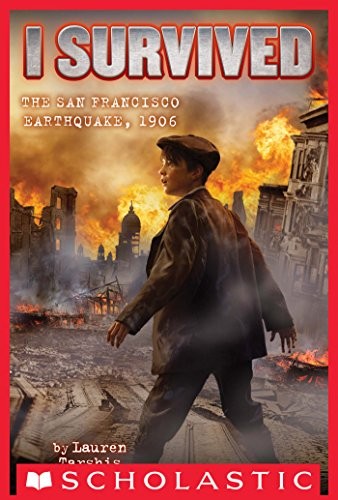
I Survived Comprehension Questions & Reading Journal
3.3 out of 5, (7 ratings on Open Library)
I Survived has 15 chapters · Grades 3–5 · 112 pages
Part of the I Survived series
Free, no sign-up. Customise to reword questions or add your reader’s name.
Inside the journal: 15 chapter pages, one question each · 3 example answers · a cover for your reader’s name
Written for this book Questions about this story, good after any chapter.
So far, what important facts have you learned about Leo, San Francisco in 1906, and Leo's life as a paperboy? Which details seem most important to remember?See all 15 questions ↓
A printable reading journal for I Survived: one question per chapter, with example answers.
Buy the book on Amazon ↗ (affiliate link)
I Survived questions by chapter
We know the book, its characters, setting and story, but not what happens in each chapter. So every question is written for this book, and any of them works wherever your reader has just stopped. One question per chapter, across all 15 chapters, and every one is editable before you print. The example answers under 3 of the chapters are the ones printed at the front of the booklet.
-
Chapter 1
So far, what important facts have you learned about Leo, San Francisco in 1906, and Leo's life as a paperboy? Which details seem most important to remember?
-
Chapter 2
Based on this chapter, how would you describe Leo as a person? Use one choice, thought, or action from the chapter to support your answer.
-
Chapter 3
How does Lauren Tarshis make San Francisco feel like a real place in this chapter? Describe two setting details that helped you picture the city.
Example answer: I could picture San Francisco because the author includes details about busy streets and people doing everyday jobs, like selling newspapers. Those details make the city feel alive instead of just being a place on a map. I also noticed details connected to the earthquake and fires, which remind me that this is a real historical disaster. The setting feels exciting but also dangerous.
-
Chapter 4
What danger, problem, or mystery seems most important right now? What clues in the chapter make you think it will matter later?
-
Chapter 5
Choose one strong word or phrase from this chapter, especially one connected to newspapers, earthquakes, fire, or city life. What do you think it means, and why did the author choose it?
-
Chapter 6
In this chapter, where do you see courage, fear, or both? Explain how Leo or another character reacts when things feel difficult or scary.
-
Chapter 7
How do Leo's relationships with other people affect what he does in this chapter? Explain how one person helps, worries, challenges, or motivates him.
-
Chapter 8
What is the biggest problem Leo faces in the chapter you just read, and how does he respond to it? What does his response show about him?
Example answer: The biggest problem Leo faces is that he has to figure out what to do when his world feels unsafe and confusing. He does not just give up, even when he is scared. He keeps thinking about what matters and tries to make smart choices. That shows me he is brave, but he is still a realistic kid.
-
Chapter 9
If you could step into this chapter and talk to Leo, what advice would you give him? Explain why that advice would be helpful in this part of the story.
-
Chapter 10
Choose one event from this chapter and explain its cause and effect. What made it happen, and how did it change Leo's situation?
-
Chapter 11
What mood or feeling does this chapter create for you as a reader? Tell which words, events, or details make the chapter feel that way.
-
Chapter 12
This book is historical fiction. What details in this chapter teach you about life in 1906, and what parts feel like they belong to Leo's made-up story?
Example answer: The historical parts teach me about San Francisco in 1906, including the newspaper business, the city streets, and the danger from the earthquake and fire. Those details help me learn what life might have been like back then. Leo's personal thoughts, problems, and friendships feel like the fiction part because they are part of his story. I like how the author mixes facts with an exciting character.
-
Chapter 13
What choices in this chapter seem to help characters stay safe, and what choices seem risky? Explain your thinking using details from the text.
-
Chapter 14
So far, what message might the story be giving about survival, friendship, family, or community during a disaster? Support your idea with an example.
-
Chapter 15
After reading this chapter, what feels answered, and what are you still wondering about? Explain what you think is important for the story now.
Discussion questions for after I Survived
Bigger questions for when the book is finished, each printed on its own ruled page at the end of the booklet.
- By the end of the book, how has Leo changed from the beginning of the story? Write about what he learns from the earthquake, the fire, and the people around him, using several examples from across the book.
- What do you think this book is really about besides surviving a disaster? Explain how the story shows ideas such as bravery, family, friendship, community, or hope, and tell whether you would recommend it to another reader.
More in I Survived
All 5 →-
 Book 1
I Survived the Sinking of the Titanic, 1912
-
 Book 17
I survived the attack of the grizzlies, 1967
-
 Book 23
I Survived the Great Alaska Earthquake 1964
-
 I Survived the Eruption of Mount St. Helens, 1980
More by Lauren Tarshis
All 9 →-
 I Survived Hurricane Katrina, 2005 (Graphic Novel)
-
 I Survived The Attacks of September 11, 2001
-
 I Survived The Bombing Of Pearl Harbor, 1941
-
 I Survived the Great Chicago Fire, 1871
Similar books for grades 3–5
-
 Karen's New Year.
-
 Kiki and the New Magic
-
 Kiki's Delivery Service
-
 Kristy's Big Day
-
 Kristy's Great Idea
-
 Leon the Extraordinary
How to use this I Survived reading journal
At home, as a discussion guide
After each chapter your reader writes a few lines on that chapter’s question. Read the answer together at bedtime: it shows what they understood and gives you something real to talk about, without a quiz.
In class, as a novel study
Print a class set (booklets fold from plain letter paper) and use one question per chapter as the reading-response or literature-circle prompt. The example answers at the front show what a full answer looks like.
Homeschool
One booklet covers the whole book, 15 chapters, so it doubles as the reading log for I Survived. Reword any question before printing to match your reader.
Printing
The booklet PDF prints on ordinary 8.5 × 11 paper: print double-sided (flip on the short edge) at 100%, fold the stack in half and staple on the fold. There is also a one-page-per-sheet PDF and A5 binder pages.
Where the questions come from
Questions about this story, good after any chapter. We know the book, its characters, setting and story, but not what happens in each chapter. So every question is written for this book, and any of them works wherever your reader has just stopped. The questions were drafted with AI from what is known about the book and checked before publishing; every one is editable before you print.
Browse: 3rd grade books · 4th grade books · 5th grade books · All books by Lauren Tarshis