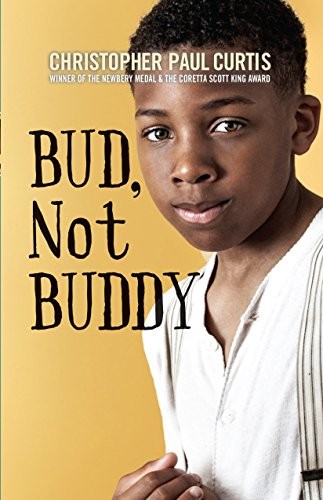
Bud, Not Buddy Comprehension Questions & Reading Journal
4.5 out of 5, (33 ratings on Open Library)
Bud, Not Buddy has 19 chapters · Grades 5–7 · 246 pages
It's 1936, in Flint, Michigan. Times may be hard, and ten-year-old Bud may be a motherless boy on the run, but Bud's got a few things going for him: 1.
Free, no sign-up. Customise to reword questions or add your reader’s name.
Inside the journal: 19 chapter pages, one question each · 3 example answers · a cover for your reader’s name
Written for this book Questions about this story, good after any chapter.
What is the most important problem Bud faces at this point in your reading? Explain what makes it difficult and what he can do about it.See all 19 questions ↓
About the book
It's 1936, in Flint, Michigan. Times may be hard, and ten-year-old Bud may be a motherless boy on the run, but Bud's got a few things going for him: 1. He has his own suitcase filled with his own important, secret things. 2. He's the author of Bud Caldwell's Rules and Things for Having a Funner Life and Making a Better Liar Out of Yourself. 3. His momma never told him who his father was, but she left a clue: flyers of Herman E. Calloway and his famous band, the Dusky Devastators of the Depression!!!!!!
Buy the book on Amazon ↗ (affiliate link)
Bud, Not Buddy questions by chapter
We know the book, its characters, setting and story, but not what happens in each chapter. So every question is written for this book, and any of them works wherever your reader has just stopped. One question per chapter, across all 19 chapters, and every one is editable before you print. The example answers under 3 of the chapters are the ones printed at the front of the booklet.
-
Chapter 1
What is the most important problem Bud faces at this point in your reading? Explain what makes it difficult and what he can do about it.
-
Chapter 2
What do Bud’s words or thoughts reveal about how he wants other people to see him? Support your answer with a detail from your reading so far.
Example answer: I think Bud wants people to see him as someone who deserves respect, not just as a helpless little boy. His insistence on being called Bud instead of Buddy shows that he wants control over how people address him. I notice that even a name matters when other parts of his life are out of his control. This makes his correction seem important rather than rude to me.
-
Chapter 3
Based on the clues you have read, what do you predict Bud will try next? Explain why that choice would make sense to him.
-
Chapter 4
How does life during the Great Depression shape Bud’s choices so far? Use a detail about money, food, shelter, or work to explain your thinking.
-
Chapter 5
Choose an interesting word or expression from Bud’s narration in your reading today. What does it mean in context, and how does it help you hear his personality?
-
Chapter 6
Which of Bud’s decisions so far do you most agree or disagree with? Explain your view while considering what he knows at the time.
-
Chapter 7
What is something Bud knows for certain about his family, and what is something he only believes or hopes? Explain the difference using what you have read.
-
Chapter 8
How do Bud Caldwell’s Rules and Things help you understand his experiences? Discuss a rule you have encountered, or explain why he might feel he needs rules.
-
Chapter 9
What does Bud’s suitcase reveal about what matters to him? Choose an item or a detail about how he treats the suitcase, and explain its importance.
Example answer: I think Bud’s suitcase is like a small piece of home that he can carry. The flyers his mother left connect him to her and give him a possible clue about his father. I can see why these papers matter more to him than they might to someone else. Keeping them safe helps him hold on to both his memories and his hopes.
-
Chapter 10
Which unanswered question about Bud’s past interests you most right now? Explain what made you curious and what kind of clue might help answer it.
-
Chapter 11
How does Bud decide whether another person can be trusted? Describe a sign he notices, and explain whether you think it is a reliable sign.
-
Chapter 12
Where have you noticed humor in Bud’s telling of a difficult experience? Explain how the humor affects your understanding of his feelings.
Example answer: I notice humor in the long title of Bud Caldwell’s Rules and Things for Having a Funner Life and Making a Better Liar Out of Yourself. It sounds like a funny guidebook, even though needing rules for dealing with people suggests that life has been hard for him. I think the humor helps Bud feel prepared instead of powerless. It makes me smile, but it also makes me wonder how many disappointments taught him those rules.
-
Chapter 13
Find a word or phrase in your reading today that connects to safety, danger, or belonging. Explain its meaning in the passage and why it matters to Bud.
-
Chapter 14
Describe a moment so far when Bud is treated fairly or unfairly. What makes you judge the treatment that way, and what would a fair response look like?
-
Chapter 15
Which small detail from your reading today seems especially worth remembering? Explain what it helps you understand or what it makes you wonder.
-
Chapter 16
How does Bud’s connection to his mother affect his thinking so far? Use a memory, possession, or thought about her to support your answer.
-
Chapter 17
What has the story suggested so far about the difference between having a place to stay and feeling at home? Connect your thinking to Bud’s situation.
-
Chapter 18
How does hearing the story from Bud’s point of view affect your reaction to an event you have read? Explain what you understand about him that another character might miss.
-
Chapter 19
Why might the difference between “Bud” and “Buddy” matter so much to Bud? Use your reading so far to explain what his name suggests about identity or respect.
Discussion questions for after Bud, Not Buddy
Bigger questions for when the book is finished, each printed on its own ruled page at the end of the booklet.
- How does Bud’s understanding of family and belonging change across the novel? Compare his thinking near the beginning with his thinking later, and explain how particular people and experiences help bring about that change.
- What do you think Bud, Not Buddy is really saying about hope during hard times? Develop your answer using several moments from Bud’s journey, including how his memories, rules, and relationships help or limit him.
Similar books for grades 5–7
-
 I Survived the Sinking of the Titanic, 1912
-
 If the Shoe Fits
-
 Impossible Creatures
-
 Impossible Escape
-
 InvestiGators: Weather or Not
-
 Invisible Isabel
How to use this Bud, Not Buddy reading journal
At home, as a discussion guide
After each chapter your reader writes a few lines on that chapter’s question. Read the answer together at bedtime: it shows what they understood and gives you something real to talk about, without a quiz.
In class, as a novel study
Print a class set (booklets fold from plain letter paper) and use one question per chapter as the reading-response or literature-circle prompt. The example answers at the front show what a full answer looks like.
Homeschool
One booklet covers the whole book, 19 chapters, so it doubles as the reading log for Bud, Not Buddy. Reword any question before printing to match your reader.
Printing
The booklet PDF prints on ordinary 8.5 × 11 paper: print double-sided (flip on the short edge) at 100%, fold the stack in half and staple on the fold. There is also a one-page-per-sheet PDF and A5 binder pages.
Where the questions come from
Questions about this story, good after any chapter. We know the book, its characters, setting and story, but not what happens in each chapter. So every question is written for this book, and any of them works wherever your reader has just stopped. The questions were drafted with AI from what is known about the book and checked before publishing; every one is editable before you print.
Browse: 5th grade books · 6th grade books · 7th grade books