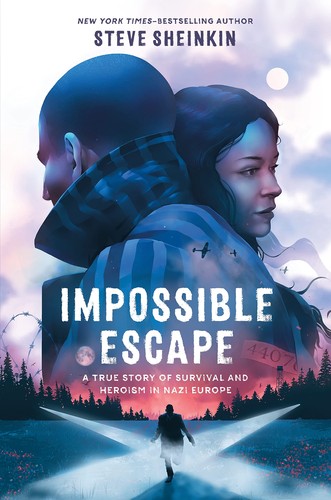
Impossible Escape Comprehension Questions & Reading Journal
Impossible Escape has 39 chapters · Grades 5–7 · 243 pages
Free, no sign-up. Customise to reword questions or add your reader’s name.
Inside the journal: 39 chapter pages, one question each · 3 example answers · a cover for your reader’s name
Open-ended Thought-provoking questions for any chapter book.
So far, what have you learned about Walter Rosenberg, also known as Rudi Vrba, and what details make him seem like a real person instead of just a figure from history?See all 39 questions ↓
A printable reading journal for Impossible Escape: one question per chapter, with example answers.
Buy the book on Amazon ↗ (affiliate link)
Impossible Escape questions by chapter
We don’t know this book well enough to ask about its story, so these are open-ended prompts that get a reader thinking about the chapter they just finished: what happened, who changed, what they would do. One question per chapter, across all 39 chapters, and every one is editable before you print. The example answers under 3 of the chapters are the ones printed at the front of the booklet.
-
Chapter 1
So far, what have you learned about Walter Rosenberg, also known as Rudi Vrba, and what details make him seem like a real person instead of just a figure from history?
-
Chapter 2
How does Steve Sheinkin help you understand the danger of Nazi Europe in the chapter you just read? Use one or two details from the text.
Example answer: Sheinkin helps me understand the danger by showing how people could lose their freedom very quickly. The chapter made the rules and threats feel scary because they affected real families and real choices. I also noticed that the danger was not only from one moment, but from a whole system of control. That made the history feel more serious and personal.
-
Chapter 3
What choice has Rudi or another person faced so far, and why was that choice difficult?
-
Chapter 4
Which setting described in this chapter felt most important, and how did it affect the people in it?
-
Chapter 5
What is one new fact you learned about the Holocaust, Slovakia, or Auschwitz from this chapter, and why did it stand out to you?
-
Chapter 6
How does the author build suspense in the part you just read, even though this is nonfiction?
-
Chapter 7
What do Rudi's actions so far show about his personality, such as courage, curiosity, intelligence, or determination?
Example answer: I think Rudi shows that he is very observant and determined. He does not seem like someone who just accepts danger without thinking about what is happening around him. I noticed that he pays attention to details, which could help him understand patterns and survive. To me, that makes him brave in a quiet but important way.
-
Chapter 8
Choose one word or phrase from this chapter that felt powerful or unfamiliar. What do you think it means, and how did it shape the mood?
-
Chapter 9
What question would you ask Rudi if you could talk to him at this point in the book, and why?
-
Chapter 10
How are fear and hope both present in the chapter you just read?
Example answer: Fear is present because the people in the book are living under terrible pressure and do not know what will happen next. At the same time, I saw hope in the way Rudi keeps thinking, watching, and looking for chances to survive. The hope does not make the chapter happy, but it keeps it from feeling completely helpless. I think that mix of fear and hope makes the story powerful.
-
Chapter 11
What does this chapter show about how the Nazis used rules, lies, or force to control people?
-
Chapter 12
Describe a moment when someone paid close attention to details. Why might noticing details matter in a story about survival?
-
Chapter 13
What is one thing you think Steve Sheinkin wants readers to feel or understand after this chapter?
-
Chapter 14
How has your opinion of Rudi changed or grown based on what you read today?
-
Chapter 15
What prediction can you make about a problem Rudi or others may face next, based only on what has happened so far?
-
Chapter 16
How does this chapter show the importance of memory, truth, or telling what happened?
-
Chapter 17
What is one small act of resistance or bravery you noticed so far, and why does it matter?
-
Chapter 18
How does the author use specific names, places, dates, or numbers to make the history feel more real?
-
Chapter 19
Which person in this chapter did you want to know more about, and what made that person interesting?
-
Chapter 20
What emotions did you feel while reading this chapter, and which part of the text caused those feelings?
-
Chapter 21
How does the chapter show that survival can depend on both luck and choices?
-
Chapter 22
What is one connection you can make between this chapter and something you have learned in school, read in another book, or seen in a documentary?
-
Chapter 23
What information in this chapter seems especially important to remember for later in the book? Explain your thinking.
-
Chapter 24
How does Sheinkin balance telling a historical fact with telling a story that keeps readers interested?
-
Chapter 25
What did you notice about friendship, trust, or teamwork in the chapter you just read?
-
Chapter 26
What is one example of unfairness or cruelty in this chapter, and how did people respond to it?
-
Chapter 27
If this chapter had a one-sentence lesson or warning, what would it be?
-
Chapter 28
What was the most tense or serious moment in the chapter, and how did the author make it feel that way?
-
Chapter 29
How does Rudi use his mind, not just his body, to deal with danger so far?
-
Chapter 30
What part of this chapter was hardest to read, and why do you think books for young readers still include difficult history?
-
Chapter 31
How did the chapter change what you understand about Auschwitz or the larger system of Nazi persecution?
-
Chapter 32
What is one decision made by a bystander, prisoner, Nazi officer, or helper in this chapter, and what effect did it have?
-
Chapter 33
How does the author show that ordinary people can be pushed into extraordinary situations?
-
Chapter 34
Pick a detail from this chapter that you can picture clearly. What makes that image stay in your mind?
-
Chapter 35
What do you think courage means in the world of this book so far? Give an example from the chapter.
-
Chapter 36
How does this chapter make you think about the responsibility people have to speak up when something is wrong?
-
Chapter 37
What is one thing you admired, questioned, or disagreed with in someone's actions in this chapter?
-
Chapter 38
How does the pacing of this chapter—fast, slow, or changing—affect the way you read it?
-
Chapter 39
What do you want to keep watching for as you continue reading Impossible Escape, and why?
Discussion questions for after Impossible Escape
Bigger questions for when the book is finished, each printed on its own ruled page at the end of the booklet.
- By the end of Impossible Escape, how has Walter Rosenberg/Rudi Vrba changed from the person you met at the beginning? Write about the experiences, choices, and people that shaped him, and explain which change seemed most important to you.
- What do you think Impossible Escape is really about beyond one person's survival? In your answer, discuss the book's ideas about truth, memory, courage, and the responsibility to tell others what happened.
More by Steve Sheinkin
All 2 →
Similar books for grades 5–7
-
 Will's Race for Home
-
 Wish
-
 Witchward Bound
-
 Wombat Waiting
-
 A Hero's Guide to Summer Vacation
-
 A Wrinkle in Time
How to use this Impossible Escape reading journal
At home, as a discussion guide
After each chapter your reader writes a few lines on that chapter’s question. Read the answer together at bedtime: it shows what they understood and gives you something real to talk about, without a quiz.
In class, as a novel study
Print a class set (booklets fold from plain letter paper) and use one question per chapter as the reading-response or literature-circle prompt. The example answers at the front show what a full answer looks like.
Homeschool
One booklet covers the whole book, 39 chapters, so it doubles as the reading log for Impossible Escape. Reword any question before printing to match your reader.
Printing
The booklet PDF prints on ordinary 8.5 × 11 paper: print double-sided (flip on the short edge) at 100%, fold the stack in half and staple on the fold. There is also a one-page-per-sheet PDF and A5 binder pages.
Where the questions come from
Thought-provoking questions for any chapter book. We don’t know this book well enough to ask about its story, so these are open-ended prompts that get a reader thinking about the chapter they just finished: what happened, who changed, what they would do. The questions were drafted with AI from what is known about the book and checked before publishing; every one is editable before you print.
Browse: 5th grade books · 6th grade books · 7th grade books · All books by Steve Sheinkin