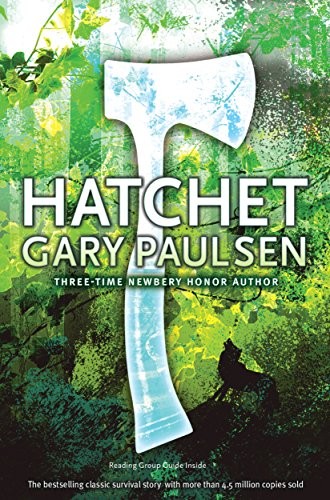
Hatchet Comprehension Questions & Reading Journal
4.2 out of 5, (156 ratings on Open Library)
Hatchet has 14 chapters · 192 pages
Brian Robison, a teenage boy struggling through his parents divorce, is flying up north to stay with his dad for the summer. However, his plane crashes and he is forced to survive the Canadian wilderness.
Free, no sign-up. Customise to reword questions or add your reader’s name.
Inside the journal: 14 chapter pages, one question each · 3 example answers · a cover for your reader’s name
Chapter by chapter Each question is about its own chapter.
What important problem happens on the plane, and how does Brian react at first?See all 14 questions ↓
About the book
Brian Robison, a teenage boy struggling through his parents divorce, is flying up north to stay with his dad for the summer. However, his plane crashes and he is forced to survive the Canadian wilderness. Now living in a world completely opposite of his own, he is now able to discover himself in this forsaken and misunderstood beautiful world.
Buy the book on Amazon ↗ (affiliate link)
Hatchet questions by chapter
We know this book well. Every question asks about something that happens in its chapter, a moment, a choice or a character, without giving away what comes next. One question per chapter, across all 14 chapters, and every one is editable before you print. The example answers under 3 of the chapters are the ones printed at the front of the booklet.
-
Chapter 1
What important problem happens on the plane, and how does Brian react at first?
-
Chapter 2
Brian has to make choices quickly after the pilot gets sick. What does he do to try to help himself, and what does this show about him?
-
Chapter 3
Describe the plane crash in your own words. What details make the scene feel scary or intense?
-
Chapter 4
Brian wakes up after the crash and notices the world around him. What are some of the first challenges he faces?
-
Chapter 5
Brian starts thinking about what he needs to survive. Which need seems most important right away, and why?
Example answer: I think water seems most important right away because Brian is very thirsty and cannot live long without it. He is near the lake, so he has a way to drink, even though he is not sure if it is safe. Food matters too, but his body needs water first. This shows that Brian is starting to think like a survivor.
-
Chapter 6
Brian chooses a place for shelter. What makes this spot helpful, and what problems might it still have?
-
Chapter 7
Brian eats berries and learns an important lesson. What does he learn from this mistake?
-
Chapter 8
The porcupine hurts Brian, but it also leads to a discovery. How does this event help Brian understand something new?
-
Chapter 9
Brian works hard to make fire. Why is fire so important to him, both for survival and for his feelings?
Example answer: Fire is important because it can help Brian stay warm, keep animals away, and maybe cook food later. It also makes him feel less alone because it is something he created by himself. I think the fire gives him hope. After working so hard, Brian can see that he is capable of solving hard problems.
-
Chapter 10
Brian finds turtle eggs near the lake. How does this discovery change his chances of surviving?
-
Chapter 11
Brian begins to notice more details in nature. How is he changing as a person because of his time in the wilderness?
-
Chapter 12
Brian feels crushed when the search plane leaves without seeing him. What might happen next because of this disappointment?
-
Chapter 13
Brian thinks about being a new version of himself. What does that mean, and how is this Brian different from the Brian at the beginning?
Example answer: The new Brian is stronger and more careful than he was at the beginning. Before the crash, he depended on adults and did not know much about living in nature. Now he watches, listens, and learns from every mistake. I think he is also braver because he keeps trying even when things are difficult.
-
Chapter 14
After the skunk takes his turtle eggs, Brian changes his shelter and storage. What does this show about how he learns from problems?
More ready-made journals
-
 Tales from a Not-so-popular Party Girl
-
 Tales of a Fourth Grade Nothing
-
 Talons of Power
-
 Tears of a Tiger
-
 Thanks a million
-
 The absent author
How to use this Hatchet reading journal
At home, as a discussion guide
After each chapter your reader writes a few lines on that chapter’s question. Read the answer together at bedtime: it shows what they understood and gives you something real to talk about, without a quiz.
In class, as a novel study
Print a class set (booklets fold from plain letter paper) and use one question per chapter as the reading-response or literature-circle prompt. The example answers at the front show what a full answer looks like.
Homeschool
One booklet covers the whole book, 14 chapters, so it doubles as the reading log for Hatchet. Reword any question before printing to match your reader.
Printing
The booklet PDF prints on ordinary 8.5 × 11 paper: print double-sided (flip on the short edge) at 100%, fold the stack in half and staple on the fold. There is also a one-page-per-sheet PDF and A5 binder pages.
Where the questions come from
Each question is about its own chapter. We know this book well. Every question asks about something that happens in its chapter, a moment, a choice or a character, without giving away what comes next. The questions were drafted with AI from what is known about the book and checked before publishing; every one is editable before you print.