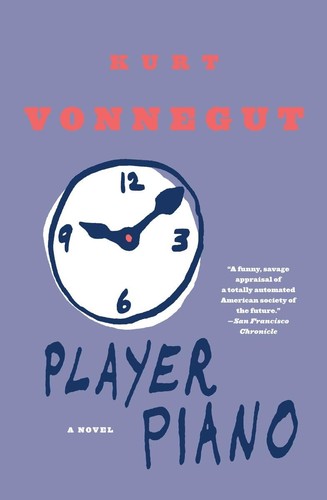
Player Piano Comprehension Questions & Reading Journal
3.8 out of 5, (29 ratings on Open Library)
Player Piano has 35 chapters · 310 pages
Part of the Avon book -- YW287 series
Vonnegut's first novel spins the chilling tale of engineer Paul Proteus, who must find a way to live in a world dominated by a super computer and run completely by machines.
Free, no sign-up. Customise to reword questions or add your reader’s name.
Inside the journal: 35 chapter pages, one question each · 3 example answers · a cover for your reader’s name
Chapter by chapter Each question is about its own chapter.
What do you learn about the city of Ilium and the machines that run much of it? How does this setting make the world of the story feel?See all 35 questions ↓
About the book
Vonnegut's first novel spins the chilling tale of engineer Paul Proteus, who must find a way to live in a world dominated by a super computer and run completely by machines. Paul's rebellion is vintage Vonnegut - wildly funny, deadly serious, and terrifyingly close to reality.
Buy the book on Amazon ↗ (affiliate link)
Player Piano questions by chapter
We know this book well. Every question asks about something that happens in its chapter, a moment, a choice or a character, without giving away what comes next. One question per chapter, across all 35 chapters, and every one is editable before you print. The example answers under 3 of the chapters are the ones printed at the front of the booklet.
-
Chapter 1
What do you learn about the city of Ilium and the machines that run much of it? How does this setting make the world of the story feel?
-
Chapter 2
How does Paul Proteus seem to feel about his important job? Use details from the chapter to explain your thinking.
-
Chapter 3
What do Paul and Anita seem to want from life? In what ways are their hopes the same or different?
-
Chapter 4
Finnerty comes back into Paul's life. What kind of person does Finnerty seem to be, and how does he affect Paul?
-
Chapter 5
The Shah and his helper see America from the outside. What questions or surprises do they have about this society?
-
Chapter 6
What is Homestead like compared with the richer, machine-run parts of Ilium? How do people there seem to feel about their lives?
-
Chapter 7
The word automation means using machines to do work people used to do. How does automation help people in this chapter, and how does it hurt them?
Example answer: I think automation helps because the machines can do jobs quickly and make things run smoothly. But it also hurts people because many workers do not feel needed anymore. In the story, some people have lost pride because a machine has taken over what they used to do. That makes me think technology can be useful, but it should not make people feel worthless.
-
Chapter 8
Why is Paul interested in the old farm? What might the farm stand for in his life?
-
Chapter 9
How do Paul's bosses try to guide or control him? What does this show about power in the story?
-
Chapter 10
Lasher talks about work, pride, and people feeling useful. What is one idea he shares that seems important?
-
Chapter 11
How does Shepherd act toward Paul? What does their relationship show about competition and success?
-
Chapter 12
Paul feels pulled in different directions. What choices does he seem to be facing, and why are they hard?
-
Chapter 13
At the Meadows, leaders gather for a special event. What do you notice about how they talk and behave together?
-
Chapter 14
What does the Meadows event teach Paul about the leaders of this society? Does he feel more included or more doubtful?
-
Chapter 15
The leaders play games and follow rules at the Meadows. How do these games connect to the way their whole society works?
-
Chapter 16
How does Paul handle the pressure to fit in at the Meadows? What does his behavior tell you about him?
-
Chapter 17
What does Paul learn about trust and loyalty in this chapter? How do other characters make trust difficult?
-
Chapter 18
Paul keeps thinking about the farm and a different kind of life. What do you predict he will choose, and why?
Example answer: I predict Paul will keep wanting the farm, even if it causes problems. The farm seems peaceful and real to him, unlike his job where he feels trapped. I think he wants to make his own choices instead of always doing what the company expects. He may not know exactly what to do yet, but he seems ready for a change.
-
Chapter 19
How does Anita react to Paul's ideas about changing their life? What does her reaction show about what she values?
-
Chapter 20
The story shows people being judged by tests, jobs, and ranks. Do you think this is a fair way to measure a person? Why or why not?
-
Chapter 21
Paul learns more about the people who want to fight the machine-run system. What reasons do they have for wanting change?
-
Chapter 22
Lasher and others talk about dignity, which means feeling worthy and respected. How are people in the story losing their dignity?
-
Chapter 23
Paul must decide whether to stay safe or take a risk. What would make this decision difficult for him?
-
Chapter 24
How do the secret plans create suspense in this chapter? What details make you wonder what will happen next?
-
Chapter 25
The government and company leaders watch people closely. How does this make the characters feel, and why?
-
Chapter 26
The Shah's visit helps readers see America in a new way. What does he notice that the Americans might not notice about themselves?
-
Chapter 27
Paul gets into serious trouble. How does he respond when he is accused or questioned?
-
Chapter 28
During Paul's trial, what do different people believe about him? How does the trial show the main conflict of the book?
-
Chapter 29
The rebels prepare to act. What hopes do they have, and what problems might stop them?
-
Chapter 30
When the rebellion begins, what changes quickly? How do people react when the machines and systems are attacked?
-
Chapter 31
Some people seem excited when machines are broken. Why might breaking the machines feel good to them at first?
Example answer: I think breaking the machines feels good to them because the machines have made them feel powerless for a long time. When they smash them, they finally feel like they can do something. It is like they are taking back control for a moment. But I also think it may not solve everything, because people still need a better plan for how to live afterward.
-
Chapter 32
How do the leaders and soldiers respond to the rebellion? What does their response show about keeping control?
-
Chapter 33
After the damage, some people begin fixing machines again. Why is this surprising, and what might it mean?
-
Chapter 34
What lesson does Paul seem to learn about people, machines, and habits? Explain using events from this part of the story.
-
Chapter 35
The ending is not completely happy or simple. What message do you think the author wants readers to think about after finishing the book?
More ready-made journals
-
 Ellray Jakes Rocks The Holidays!
-
 Escape From Mr. Lemoncello's Library
-
 Escaping the giant wave
-
 Esperanza Rising
-
 Eyeshield 21
-
 Fantastic Mr Fox
How to use this Player Piano reading journal
At home, as a discussion guide
After each chapter your reader writes a few lines on that chapter’s question. Read the answer together at bedtime: it shows what they understood and gives you something real to talk about, without a quiz.
In class, as a novel study
Print a class set (booklets fold from plain letter paper) and use one question per chapter as the reading-response or literature-circle prompt. The example answers at the front show what a full answer looks like.
Homeschool
One booklet covers the whole book, 35 chapters, so it doubles as the reading log for Player Piano. Reword any question before printing to match your reader.
Printing
The booklet PDF prints on ordinary 8.5 × 11 paper: print double-sided (flip on the short edge) at 100%, fold the stack in half and staple on the fold. There is also a one-page-per-sheet PDF and A5 binder pages.
Where the questions come from
Each question is about its own chapter. We know this book well. Every question asks about something that happens in its chapter, a moment, a choice or a character, without giving away what comes next. The questions were drafted with AI from what is known about the book and checked before publishing; every one is editable before you print.