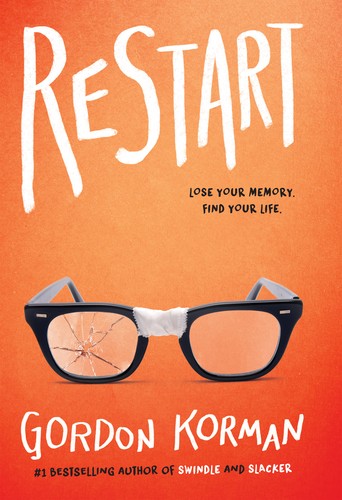
Restart Comprehension Questions & Reading Journal
3.8 out of 5, (18 ratings on Open Library)
Restart has 30 chapters · 256 pages
Free, no sign-up. Customise to reword questions or add your reader’s name.
Inside the journal: 30 chapter pages, one question each · 3 example answers · a cover for your reader’s name
Written for this book Questions about this story, good after any chapter.
So far, what does Chase Ambrose understand about himself after losing his memory, and what is still confusing to him?See all 30 questions ↓
About the book
Chase's memory just went out the window. Chase doesn't remember falling off the roof. He doesn't remember hitting his head. He doesn't, in fact, remember anything. He wakes up in a hospital room and suddenly has to learn his whole life all over again... starting with his own name.
Buy the book on Amazon ↗ (affiliate link)
Restart questions by chapter
We know the book, its characters, setting and story, but not what happens in each chapter. So every question is written for this book, and any of them works wherever your reader has just stopped. One question per chapter, across all 30 chapters, and every one is editable before you print. The example answers under 3 of the chapters are the ones printed at the front of the booklet.
-
Chapter 1
So far, what does Chase Ambrose understand about himself after losing his memory, and what is still confusing to him?
-
Chapter 2
How do the reactions of other students at Hiawassee Middle School show what Chase was like before his accident?
Example answer: The other students’ reactions show that Chase must have been scary or mean before his accident. Some people avoid him or act nervous around him, even when he is not doing anything wrong now. That tells me his old actions hurt people and made a big impression. I think Chase is starting to realize that he has a lot to learn about who he used to be.
-
Chapter 3
What clues has the author given about why some people do not trust Chase right away?
-
Chapter 4
Choose one character who has strong feelings about Chase so far. What do those feelings tell you about that character?
-
Chapter 5
How does the school setting make it hard for Chase to figure out who he really is?
-
Chapter 6
What role does friendship play in the chapter you just read, and is it helping or hurting Chase?
-
Chapter 7
How does Chase act when he has to face a problem or an uncomfortable situation so far?
-
Chapter 8
What is one moment that made you wonder whether Chase can really change? Explain your thinking.
-
Chapter 9
How do Aaron Hakimian and Bear Bratsky influence Chase, either positively or negatively, at this point in the story?
-
Chapter 10
What have you learned about Shoshanna Weber’s point of view, and why might she see Chase differently from some other people?
-
Chapter 11
How does Gordon Korman use different characters’ points of view to help you understand the story better?
-
Chapter 12
Pick an important word or phrase from the chapter you read. What does it mean, and how does it fit the situation?
-
Chapter 13
What is one choice Chase makes so far that shows the kind of person he might become?
-
Chapter 14
How does the video club connect Chase with people he might not have spent time with before?
Example answer: The video club gives Chase a chance to be around different students instead of just his old football friends. He gets to see people’s talents and ideas in a new way. It also lets other kids see that Chase might not act like the bully they remember. I think the club is important because it helps him build a new kind of life.
-
Chapter 15
What do you notice about the way Brendan Espinoza treats Chase, and what does that show about Brendan?
-
Chapter 16
So far, how does the book show that a person’s past can affect the way others treat them in the present?
-
Chapter 17
Which character do you feel the most sympathy for right now, and what details from the story make you feel that way?
-
Chapter 18
What prediction can you make about how Chase’s relationships at school might change, based on what you have read?
-
Chapter 19
How does the author balance funny moments with serious problems in the story so far?
-
Chapter 20
What lesson about bullying or kindness is beginning to appear in the chapters you have read?
-
Chapter 21
How do adults in the story, such as teachers or family members, react to Chase, and what do their reactions reveal?
-
Chapter 22
Describe one scene that changed your opinion of a character. What did you think before, and what do you think now?
-
Chapter 23
What is one question you still have about Chase’s life before the accident, and why is that question important?
-
Chapter 24
How does Chase’s memory loss create both problems and chances for a fresh start?
-
Chapter 25
Compare Chase with another character in the story so far. How are they alike, and how are they different?
-
Chapter 26
What does the chapter you read suggest about earning forgiveness instead of just asking for it?
-
Chapter 27
How do rumors, memories, or stories from the past affect what people believe about Chase?
-
Chapter 28
Which moment in the story so far felt the most important to you, and why did it stand out?
-
Chapter 29
What do you think the title Restart means at this point in the book?
Example answer: I think Restart means that Chase has a chance to begin again because he does not remember his old life. It does not mean everything is easy, because other people still remember what he did. To me, the title is about making better choices even when your past follows you. Chase has to decide what kind of person he wants to be now.
-
Chapter 30
If you could give Chase advice based on everything you have read so far, what would you tell him and why?
Discussion questions for after Restart
Bigger questions for when the book is finished, each printed on its own ruled page at the end of the booklet.
- Think about Chase Ambrose across the whole book. How does he change, and what people, problems, or choices help him change the most? Use several examples from different parts of the story to explain your answer.
- What do you think Restart is really saying about bullying, forgiveness, and second chances? Explain how the characters and events in the book helped you understand that message.
More by Gordon Korman
All 7 →


More ready-made journals
-
 The Lion, the Witch and the Wardrobe
-
 The Lions' Run
-
 The Long Haul
-
 The Lost Heir
-
 The Lost Hero
-
 The Lost Library
How to use this Restart reading journal
At home, as a discussion guide
After each chapter your reader writes a few lines on that chapter’s question. Read the answer together at bedtime: it shows what they understood and gives you something real to talk about, without a quiz.
In class, as a novel study
Print a class set (booklets fold from plain letter paper) and use one question per chapter as the reading-response or literature-circle prompt. The example answers at the front show what a full answer looks like.
Homeschool
One booklet covers the whole book, 30 chapters, so it doubles as the reading log for Restart. Reword any question before printing to match your reader.
Printing
The booklet PDF prints on ordinary 8.5 × 11 paper: print double-sided (flip on the short edge) at 100%, fold the stack in half and staple on the fold. There is also a one-page-per-sheet PDF and A5 binder pages.
Where the questions come from
Questions about this story, good after any chapter. We know the book, its characters, setting and story, but not what happens in each chapter. So every question is written for this book, and any of them works wherever your reader has just stopped. The questions were drafted with AI from what is known about the book and checked before publishing; every one is editable before you print.
Browse: All books by Gordon Korman