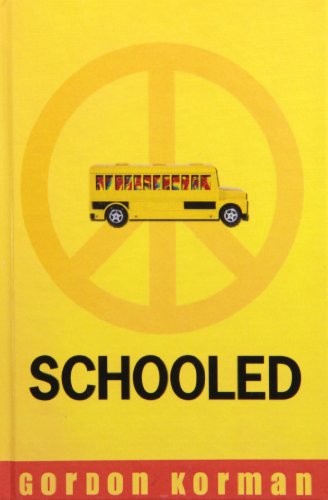
Schooled Comprehension Questions & Reading Journal
3.9 out of 5, (16 ratings on Open Library)
Schooled has 31 chapters · 208 pages
Thirteen year old Anderson has never watched t.v.
Free, no sign-up. Customise to reword questions or add your reader’s name.
Inside the journal: 31 chapter pages, one question each · 3 example answers · a cover for your reader’s name
Chapter by chapter Each question is about its own chapter.
How is Cap Anderson’s life at Garland Farm different from the lives of most kids his age, and what do those differences help you understand about him?See all 31 questions ↓
About the book
Thirteen year old Anderson has never watched t.v., or never had pizza or even heard of a wedgie. The only thing he has ever done is been home schooled by his hippie grand mother, Rain. When she broke her hip after she fell out of a tree picking plums, he is forced to stay in a foster home. Will this be his only chance to try to stop from going to a real school? Or will his bananas go rotton?
Buy the book on Amazon ↗ (affiliate link)
Schooled questions by chapter
We know this book well. Every question asks about something that happens in its chapter, a moment, a choice or a character, without giving away what comes next. One question per chapter, across all 31 chapters, and every one is editable before you print. The example answers under 3 of the chapters are the ones printed at the front of the booklet.
-
Chapter 1
How is Cap Anderson’s life at Garland Farm different from the lives of most kids his age, and what do those differences help you understand about him?
-
Chapter 2
When Rain gets hurt, Cap has to leave the only home he knows. What problems does this create for him right away?
-
Chapter 3
How does Mrs. Donnelly try to help Cap, and why do you think she feels connected to him and Garland Farm?
-
Chapter 4
Sophie does not want Cap in her home at first. What does her reaction show about her personality and her point of view?
-
Chapter 5
At school, Cap stands out right away. What are some things he does not understand about regular middle school life?
-
Chapter 6
Zach sees Cap as a good target for a prank. What does this show about Zach and the way he uses popularity?
-
Chapter 7
Hugh notices that people are paying more attention to Cap than to him. How does Hugh feel about this, and why are his feelings complicated?
-
Chapter 8
Cap is elected eighth-grade president as a joke, but he takes the job seriously. What does this tell you about Cap’s character?
Example answer: I think this shows that Cap is honest and responsible. He does not understand that the other kids are trying to make fun of him, so he just does the job the best he can. Instead of being lazy or angry, he tries to help people and make the school better. That makes me respect him.
-
Chapter 9
What are some school rules or customs that confuse Cap, and how do his reactions make the story funny or interesting?
-
Chapter 10
Cap tries to treat people kindly, even when they are not kind to him. How does this connect to the theme of being true to yourself?
-
Chapter 11
Choose one word that describes Cap in this chapter, such as innocent, brave, confused, or honest. Why is that word a good fit?
-
Chapter 12
How do Naomi and the other students begin to see Cap differently as they spend more time around him?
-
Chapter 13
Cap often misunderstands what other students mean, but he still tries to help. How can misunderstanding sometimes lead to both problems and good surprises?
-
Chapter 14
What does Hugh learn from watching the way Cap handles teasing or bullying?
-
Chapter 15
Darryl and Zach make choices that hurt Cap. Why do you think some characters follow along with mean behavior even when they know it is wrong?
-
Chapter 16
Cap’s ideas for being class president are very different from what the students expect. Which idea seems most surprising, and why?
-
Chapter 17
How does Cap’s calm way of dealing with problems affect the people around him?
-
Chapter 18
When Cap helps during a surprising emergency, how does it change what some people think about him?
-
Chapter 19
Sophie’s feelings about Cap start to change over time. What events or actions help her see him in a new way?
-
Chapter 20
What does the word popularity mean in this part of the story, and how is Cap’s kind of popularity different from Zach’s?
-
Chapter 21
Naomi begins to question Zach’s plan. What does this show about her growing sense of right and wrong?
-
Chapter 22
Cap tries to include everyone instead of leaving people out. Why is inclusion an important idea in this book?
-
Chapter 23
How does Zach react when Cap becomes more liked by other students, and what does that reaction reveal about him?
Example answer: Zach gets jealous and upset when Cap starts becoming popular. He is used to being the one everyone listens to, so he does not like losing attention. This shows that Zach cares a lot about power and what other people think of him. It also shows that he is not very secure inside.
-
Chapter 24
What does Cap miss about Garland Farm, and what might he also miss about school if he had to leave?
-
Chapter 25
How do the students show that Cap has made a difference at C Average Middle School? Use details from the chapter.
-
Chapter 26
Rain has strong ideas about the outside world. Do you agree with the way she has protected Cap? Why or why not?
-
Chapter 27
What prediction can you make about Cap’s future after the big changes in this part of the story? Explain your thinking.
-
Chapter 28
How does the school community respond when Cap is gone, and what does their response show about friendship?
-
Chapter 29
What lesson do you think Zach needs to learn by the end of the novel? Support your answer with examples from the story.
-
Chapter 30
How has Cap changed from the beginning of the book to this chapter, and how has he stayed the same?
-
Chapter 31
What do you think is the most important message of Schooled, and how does the final chapter help show that message?
Example answer: I think the most important message is that kindness can change people. Cap does not try to be cool or popular, but he treats people with respect, and that makes a big difference. By the end, many students understand that he was a real friend. The final chapter shows that being yourself can be more powerful than trying to fit in.
More by Gordon Korman
All 7 →




More ready-made journals
-
 The Lost Heir
-
 The Lost Hero
-
 The Lost Library
-
 The Lottery
-
 The Magic School Bus at the Waterworks
-
 The Magical Monarch of Mo
How to use this Schooled reading journal
At home, as a discussion guide
After each chapter your reader writes a few lines on that chapter’s question. Read the answer together at bedtime: it shows what they understood and gives you something real to talk about, without a quiz.
In class, as a novel study
Print a class set (booklets fold from plain letter paper) and use one question per chapter as the reading-response or literature-circle prompt. The example answers at the front show what a full answer looks like.
Homeschool
One booklet covers the whole book, 31 chapters, so it doubles as the reading log for Schooled. Reword any question before printing to match your reader.
Printing
The booklet PDF prints on ordinary 8.5 × 11 paper: print double-sided (flip on the short edge) at 100%, fold the stack in half and staple on the fold. There is also a one-page-per-sheet PDF and A5 binder pages.
Where the questions come from
Each question is about its own chapter. We know this book well. Every question asks about something that happens in its chapter, a moment, a choice or a character, without giving away what comes next. The questions were drafted with AI from what is known about the book and checked before publishing; every one is editable before you print.
Browse: All books by Gordon Korman