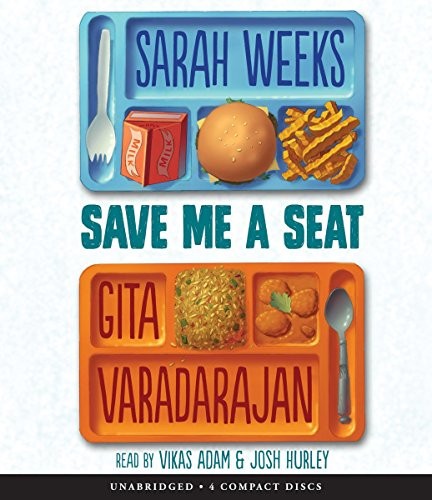
Save Me a Seat Comprehension Questions & Reading Journal
80 readers
Save Me a Seat has 49 chapters · 256 pages
Free, no sign-up. Customise to reword questions or add your reader’s name.
Inside the journal: 49 chapter pages, one question each · 3 example answers · a cover for your reader’s name
Chapter by chapter Each question is about its own chapter.
At the start of the story, what problem or worry does the narrator seem to have, and what details help you know?See all 49 questions ↓
A printable reading journal for Save Me a Seat: one question per chapter, with example answers.
Buy the book on Amazon ↗ (affiliate link)
Save Me a Seat questions by chapter
We know this book well. Every question asks about something that happens in its chapter, a moment, a choice or a character, without giving away what comes next. One question per chapter, across all 49 chapters, and every one is editable before you print. The example answers under 3 of the chapters are the ones printed at the front of the booklet.
-
Chapter 1
At the start of the story, what problem or worry does the narrator seem to have, and what details help you know?
-
Chapter 2
How does the school setting feel to Joe in this chapter? Describe one thing that makes school hard or uncomfortable for him.
-
Chapter 3
Ravi has ideas about how his first day will go. What does he expect, and how are his expectations already starting to change?
-
Chapter 4
What do you learn about Joe's relationship with his mom? How does having her at school affect him?
-
Chapter 5
Choose one word or phrase from this chapter that shows Ravi's feelings. What does it mean, and why is it important?
-
Chapter 6
Why do you think Joe notices Dillon so much? What does Dillon do that affects Joe?
-
Chapter 7
How does Ravi misunderstand something in this chapter? What clues show that he is still learning how things work at his new school?
Example answer: I think Ravi misunderstands Dillon because he thinks Dillon is being friendly and helpful. The clues show that Ravi is still learning the rules of his new school and does not know which students are trustworthy yet. Ravi is used to being confident at school, so he does not expect someone to trick him. This makes me feel worried for him because readers can see more than he can.
-
Chapter 8
What does this chapter show about Joe's auditory processing challenges? How do they affect his day?
-
Chapter 9
What opinion do you have of Ravi so far? Use evidence from the chapter to explain your thinking.
-
Chapter 10
What does Joe want other students to understand about him? How might that change the way they treat him?
-
Chapter 11
How does Ravi's family background shape the way he acts at school? Give one example from this chapter.
-
Chapter 12
What prediction can you make about Joe and Ravi after this chapter? What makes you think that?
-
Chapter 13
How does Dillon make himself look friendly or important? Why might that be confusing for Ravi?
-
Chapter 14
What is one small moment in this chapter that shows Joe is paying close attention to people around him?
-
Chapter 15
Ravi compares his old school life with his new school life. What is different, and how does that make him feel?
-
Chapter 16
What does Joe do when he feels embarrassed or overwhelmed? Do you think his response helps him? Why or why not?
-
Chapter 17
What lesson about making assumptions can readers learn from Ravi in this chapter?
-
Chapter 18
How does the author help you understand Joe's point of view in this chapter?
-
Chapter 19
Pick an unfamiliar or interesting word from this chapter. What do you think it means, and how did the sentence help you?
-
Chapter 20
What conflict is growing in the story by this point? Explain who is involved and what each person wants.
-
Chapter 21
How does Ravi react when things do not go the way he planned? What does that show about his character?
-
Chapter 22
Why is lunch an important time in the story? What do you learn about friendships or belonging during lunch?
Example answer: Lunch is important because it shows who feels included and who feels left out. At lunch, students choose where to sit, and that can make someone feel wanted or unwanted. I learn that friendship is not only about talking in class; it is also about making space for someone. Saving a seat can be a small action that means a lot.
-
Chapter 23
How does Joe's view of Ravi begin to change, or stay the same, in this chapter?
-
Chapter 24
What do you think Ravi needs most right now: a friend, help understanding school, or a chance to prove himself? Explain.
-
Chapter 25
What does Dillon's behavior teach you about bullying that is not always easy for adults to notice?
-
Chapter 26
How does Joe show courage in this chapter, even if it is a quiet kind of courage?
-
Chapter 27
What mistake does Ravi make because he trusts the wrong person? How could he have handled it differently?
-
Chapter 28
What connection can you make between Joe's feelings and a time you or someone you know felt left out?
-
Chapter 29
How does the chapter build suspense or make you wonder what will happen next?
-
Chapter 30
What does Ravi learn about being smart in a new place? How is school success different from just knowing answers?
-
Chapter 31
How do Joe's classmates or teachers respond to him in this chapter? What seems helpful or unhelpful?
-
Chapter 32
What theme, or big message, is starting to appear in the story? Use one event from this chapter to support your idea.
-
Chapter 33
How does Ravi's opinion of Dillon begin to shift? What evidence makes him question what he thought before?
-
Chapter 34
What does Joe understand about Dillon that Ravi has not fully understood yet?
-
Chapter 35
If you could give Ravi advice at this moment in the story, what would you tell him and why?
-
Chapter 36
How does teamwork start to become possible for Joe and Ravi in this chapter?
-
Chapter 37
What is one important choice a character makes in this chapter? What might happen because of that choice?
-
Chapter 38
How does the author show that Joe and Ravi are more alike than they first seemed?
-
Chapter 39
What does the word 'seat' or the idea of saving a seat mean in this part of the story?
-
Chapter 40
What prediction can you make about how the problem with Dillon might be solved? Use clues from the chapter.
-
Chapter 41
How does Ravi show growth in this chapter compared with the beginning of the book?
Example answer: Ravi shows growth because he is starting to understand people better instead of judging everything too quickly. At the beginning, he expected school to be easy for him and thought he knew who his friends were. Now he pays more attention to actions, not just words. I think this shows he is becoming more humble and more careful.
-
Chapter 42
How does Joe show growth in this chapter compared with the beginning of the book?
-
Chapter 43
What role do adults play in this chapter? Are they helping, missing the problem, or learning something too?
-
Chapter 44
What does this chapter show about standing up for yourself or for someone else?
-
Chapter 45
How do Joe and Ravi use what they know about Dillon to make a plan or solve a problem?
-
Chapter 46
What feelings did you have as the main conflict came closer to being resolved? What details made you feel that way?
-
Chapter 47
What changes in the way classmates see Joe, Ravi, or Dillon? Why do those changes matter?
-
Chapter 48
What is the most important lesson a character learns near the end of the book? Explain with an example.
-
Chapter 49
After finishing the book, what do you think the title Save Me a Seat means? How does it connect to friendship and belonging?
More ready-made journals
-
 Top Story
-
 Touching Spirit Bear
-
 Troubling tonsils!
-
 True Confessions of Charlotte Doyle
-
 Tuck Everlasting
-
 Tuesdays with Morrie
How to use this Save Me a Seat reading journal
At home, as a discussion guide
After each chapter your reader writes a few lines on that chapter’s question. Read the answer together at bedtime: it shows what they understood and gives you something real to talk about, without a quiz.
In class, as a novel study
Print a class set (booklets fold from plain letter paper) and use one question per chapter as the reading-response or literature-circle prompt. The example answers at the front show what a full answer looks like.
Homeschool
One booklet covers the whole book, 49 chapters, so it doubles as the reading log for Save Me a Seat. Reword any question before printing to match your reader.
Printing
The booklet PDF prints on ordinary 8.5 × 11 paper: print double-sided (flip on the short edge) at 100%, fold the stack in half and staple on the fold. There is also a one-page-per-sheet PDF and A5 binder pages.
Where the questions come from
Each question is about its own chapter. We know this book well. Every question asks about something that happens in its chapter, a moment, a choice or a character, without giving away what comes next. The questions were drafted with AI from what is known about the book and checked before publishing; every one is editable before you print.