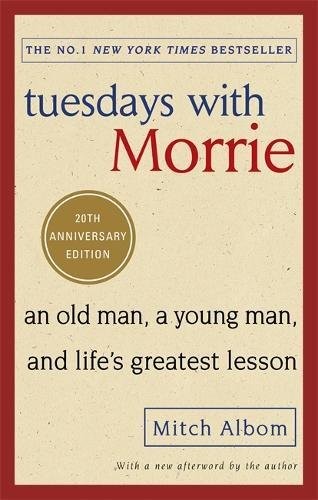
Tuesdays with Morrie Comprehension Questions & Reading Journal
3.9 out of 5, (81 ratings on Open Library)
Tuesdays with Morrie has 27 chapters · 199 pages
Part of the Wheeler large print series
Tuesdays with Morrie is a memoir by American author Mitch Albom about a series of visits Albom made to his former sociology professor Morrie Schwartz, as Schwartz gradually dies of ALS.
Free, no sign-up. Customise to reword questions or add your reader’s name.
Inside the journal: 27 chapter pages, one question each · 3 example answers · a cover for your reader’s name
Chapter by chapter Each question is about its own chapter.
In "The Curriculum," what do you learn about Morrie's illness, and why do you think the author begins the book this way?See all 27 questions ↓
About the book
Tuesdays with Morrie is a memoir by American author Mitch Albom about a series of visits Albom made to his former sociology professor Morrie Schwartz, as Schwartz gradually dies of ALS. The book topped the New York Times Non-Fiction Best-Sellers List for 23 combined weeks in 2000, and remained on the New York Times best-selling list for more than four years after. In 2006, Tuesdays with Morrie was the bestselling memoir of all time.
Buy the book on Amazon ↗ (affiliate link)
Tuesdays with Morrie questions by chapter
We know this book well. Every question asks about something that happens in its chapter, a moment, a choice or a character, without giving away what comes next. One question per chapter, across all 27 chapters, and every one is editable before you print. The example answers under 3 of the chapters are the ones printed at the front of the booklet.
-
Chapter 1
In "The Curriculum," what do you learn about Morrie's illness, and why do you think the author begins the book this way?
-
Chapter 2
In "The Syllabus," Morrie says he wants to teach lessons about life. What kinds of life lessons do you think a person can learn from someone who is very sick?
-
Chapter 3
In "The Student," how has Mitch changed since he was Morrie's student in college? Use details from the chapter to explain your thinking.
-
Chapter 4
In "The Audiovisual," Morrie appears on television. How does this show help Mitch reconnect with Morrie?
-
Chapter 5
In "The Orientation," Mitch visits Morrie after many years. What feelings do you think Mitch has during this visit, and why?
-
Chapter 6
In "The Classroom," Morrie's home becomes like a classroom. What makes Morrie a special kind of teacher?
-
Chapter 7
In "Taking Attendance," Mitch starts visiting Morrie on Tuesdays. Why do you think showing up regularly matters in their relationship?
-
Chapter 8
In "The First Tuesday: We Talk About the World," Morrie talks about caring for others. What does this chapter teach about paying attention to people beyond ourselves?
-
Chapter 9
In "The Second Tuesday: We Talk About Feeling Sorry for Yourself," Morrie explains how he handles sadness. What can readers learn from the way he deals with feeling sorry for himself?
-
Chapter 10
In "The Third Tuesday: We Talk About Regrets," Mitch brings a tape recorder and a list of questions. Why might talking about regrets be important for both Mitch and Morrie?
-
Chapter 11
In "The Audiovisual, Part Two," Morrie is interviewed again. How does Morrie's honesty affect the people watching or listening to him?
-
Chapter 12
In "The Professor," what do Morrie's past experiences show about the kind of person he became?
-
Chapter 13
In "The Fourth Tuesday: We Talk About Death," Morrie says that learning how to die can help people learn how to live. What do you think he means?
-
Chapter 14
In "The Fifth Tuesday: We Talk About Family," why is family so important to Morrie? How does he show this belief?
Example answer: I think family is important to Morrie because family gives people love and support when life is hard. He shows this by talking about how much he loves his wife and sons. Even though he is sick, he still thinks about them and wants them to feel loved. Morrie teaches that family is not just people who live with you, but people who care for you deeply.
-
Chapter 15
In "The Sixth Tuesday: We Talk About Emotions," Morrie talks about feeling emotions fully and then letting them go. How could this idea help someone in real life?
-
Chapter 16
In the second chapter called "The Professor," how did Morrie's childhood shape his ideas about love, kindness, and teaching?
-
Chapter 17
In "The Seventh Tuesday: We Talk About the Fear of Aging," Morrie has a different view of getting older. What does he think is good about aging?
-
Chapter 18
In "The Eighth Tuesday: We Talk About Money," Morrie says that money and things do not bring true happiness. Do you agree or disagree? Explain your answer.
Example answer: I agree with Morrie because having lots of things might be fun for a little while, but it does not always make someone feel loved. People need friendship, kindness, and time with family to feel truly happy. A new toy or game can break or get boring, but a good memory with someone can last a long time. Morrie helps me remember that people matter more than stuff.
-
Chapter 19
In "The Ninth Tuesday: We Talk About How Love Goes On," what does Morrie teach Mitch about love lasting even after someone is gone?
-
Chapter 20
In "The Tenth Tuesday: We Talk About Marriage," what advice does Morrie give about a strong marriage or partnership?
-
Chapter 21
In "The Eleventh Tuesday: We Talk About Our Culture," Morrie says people can build their own little culture. What kind of values would you want in your own culture?
-
Chapter 22
In "The Audiovisual, Part Three," Morrie's body is weaker, but his words are still powerful. How can someone's ideas stay strong even when their body is not?
-
Chapter 23
In "The Twelfth Tuesday: We Talk About Forgiveness," Morrie talks about forgiving others and yourself. Why can forgiveness be hard, and why can it also be helpful?
-
Chapter 24
In "The Thirteenth Tuesday: We Talk About the Perfect Day," Morrie describes a simple perfect day. What does his answer show about what matters most to him?
Example answer: Morrie's perfect day shows that he cares most about simple things and the people he loves. He does not wish for a fancy trip or a lot of money. He wants good food, dancing, and time with friends. This shows that Morrie believes happiness can come from ordinary moments when we share them with others.
-
Chapter 25
In "The Fourteenth Tuesday: We Say Good-bye," how do Mitch and Morrie show their love and friendship during their last visit?
-
Chapter 26
In "Graduation," why is Morrie's funeral called a graduation? What lesson has Mitch learned by the end of Morrie's class?
-
Chapter 27
In "Conclusion," Mitch thinks about how Morrie changed his life. What is one lesson from the book that you would want to remember?
More ready-made journals





How to use this Tuesdays with Morrie reading journal
At home, as a discussion guide
After each chapter your reader writes a few lines on that chapter’s question. Read the answer together at bedtime: it shows what they understood and gives you something real to talk about, without a quiz.
In class, as a novel study
Print a class set (booklets fold from plain letter paper) and use one question per chapter as the reading-response or literature-circle prompt. The example answers at the front show what a full answer looks like.
Homeschool
One booklet covers the whole book, 27 chapters, so it doubles as the reading log for Tuesdays with Morrie. Reword any question before printing to match your reader.
Printing
The booklet PDF prints on ordinary 8.5 × 11 paper: print double-sided (flip on the short edge) at 100%, fold the stack in half and staple on the fold. There is also a one-page-per-sheet PDF and A5 binder pages.
Where the questions come from
Each question is about its own chapter. We know this book well. Every question asks about something that happens in its chapter, a moment, a choice or a character, without giving away what comes next. The questions were drafted with AI from what is known about the book and checked before publishing; every one is editable before you print.