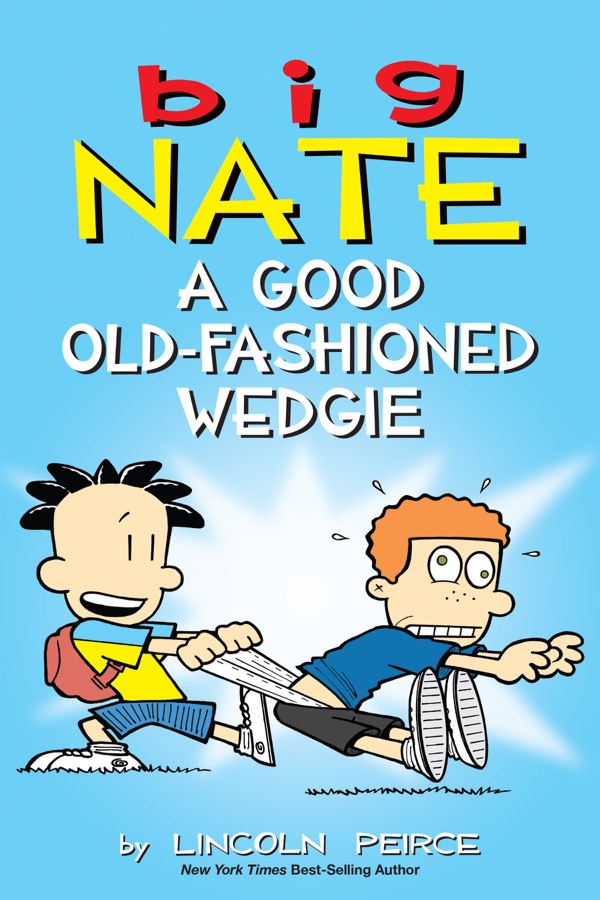
Big Nate: A Good Old-Fashioned Wedgie Comprehension Questions & Reading Journal
Big Nate: A Good Old-Fashioned Wedgie has 12 chapters
Free, no sign-up. Customise to reword questions or add your reader’s name.
Inside the journal: 12 chapter pages, one question each · 3 example answers · a cover for your reader’s name
Written for this book Questions about this story, good after any chapter.
So far, what is the main problem or funniest situation Nate Wright is dealing with in this part of the book? Explain what made it stand out to you.See all 12 questions ↓
A printable reading journal for Big Nate: A Good Old-Fashioned Wedgie: one question per chapter, with example answers.
Buy the book on Amazon ↗ (affiliate link)
Big Nate: A Good Old-Fashioned Wedgie questions by chapter
We know the book, its characters, setting and story, but not what happens in each chapter. So every question is written for this book, and any of them works wherever your reader has just stopped. One question per chapter, across all 12 chapters, and every one is editable before you print. The example answers under 3 of the chapters are the ones printed at the front of the booklet.
-
Chapter 1
So far, what is the main problem or funniest situation Nate Wright is dealing with in this part of the book? Explain what made it stand out to you.
-
Chapter 2
How does Nate act when he is at school with characters like Francis, Teddy, Gina, or Mrs. Godfrey? Use one moment from the chapter to describe his personality.
Example answer: In this chapter, Nate acts confident and a little dramatic at school. He often seems sure that his ideas are great, even when the people around him do not agree. I think this shows that Nate is funny and brave, but he does not always think carefully before he talks or acts. That is part of what makes him entertaining to read about.
-
Chapter 3
What do Nate’s thoughts, drawings, or jokes show about how he sees himself? Do you think his view of himself matches how others see him?
-
Chapter 4
Choose one friendship moment involving Nate and one of his classmates. What does it show about being a good friend, or not being a good friend?
-
Chapter 5
Find a word, phrase, or joke in this chapter that was especially funny or interesting. What do you think it means, and how did it add to the humor?
Example answer: One phrase that stood out to me was a joke Nate made to make an ordinary school problem sound much bigger than it really was. I think the joke means that Nate sees everyday events as huge adventures or disasters. That made the chapter funnier because it showed his over-the-top way of thinking. It also helped me understand his personality better.
-
Chapter 6
What prediction can you make about how Nate’s choices might affect him later in the book? Explain what clues helped you make that prediction.
-
Chapter 7
So far, how does the school setting, including places like the classroom, cafeteria, or hallway, help create funny problems for Nate?
-
Chapter 8
Which character besides Nate seems most important in this chapter? Describe what that character does and how Nate reacts to them.
-
Chapter 9
What is one lesson Nate could learn from what happened in this chapter? Do you think he is likely to learn it? Why or why not?
-
Chapter 10
How does Lincoln Peirce use comic panels, facial expressions, or speech bubbles to help tell the story in this chapter?
Example answer: Lincoln Peirce uses the pictures to show feelings quickly. When a character looks shocked, annoyed, or excited, I can understand the joke even before I finish reading the words. The speech bubbles also help because they make the conversations feel fast and funny. I think the comic style is important because the pictures and words work together.
-
Chapter 11
What part of this chapter did you have the strongest opinion about? Tell whether you thought it was funny, unfair, surprising, or confusing, and explain why.
-
Chapter 12
If you could ask Nate one question about what he did or said in this chapter, what would you ask? Why would that question help you understand him better?
Discussion questions for after Big Nate: A Good Old-Fashioned Wedgie
Bigger questions for when the book is finished, each printed on its own ruled page at the end of the booklet.
- After finishing Big Nate: A Good Old-Fashioned Wedgie, what do you think Nate Wright is really like as a character? Write about his strengths, his mistakes, and whether your opinion of him changed as you read the whole book.
- Would you recommend this Big Nate book to another upper elementary reader? Explain who would enjoy it most, what kind of humor or school situations they should expect, and which part of the book best supports your recommendation.
More by LINCOLN PEIRCE
All 3 →
More ready-made journals
-
 I Survived
-
 I Survived Hurricane Katrina, 2005 (Graphic Novel)
-
 I survived the attack of the grizzlies, 1967
-
 I Survived The Attacks of September 11, 2001
-
 I Survived The Bombing Of Pearl Harbor, 1941
-
 I Survived the Eruption of Mount St. Helens, 1980
How to use this Big Nate: A Good Old-Fashioned Wedgie reading journal
At home, as a discussion guide
After each chapter your reader writes a few lines on that chapter’s question. Read the answer together at bedtime: it shows what they understood and gives you something real to talk about, without a quiz.
In class, as a novel study
Print a class set (booklets fold from plain letter paper) and use one question per chapter as the reading-response or literature-circle prompt. The example answers at the front show what a full answer looks like.
Homeschool
One booklet covers the whole book, 12 chapters, so it doubles as the reading log for Big Nate: A Good Old-Fashioned Wedgie. Reword any question before printing to match your reader.
Printing
The booklet PDF prints on ordinary 8.5 × 11 paper: print double-sided (flip on the short edge) at 100%, fold the stack in half and staple on the fold. There is also a one-page-per-sheet PDF and A5 binder pages.
Where the questions come from
Questions about this story, good after any chapter. We know the book, its characters, setting and story, but not what happens in each chapter. So every question is written for this book, and any of them works wherever your reader has just stopped. The questions were drafted with AI from what is known about the book and checked before publishing; every one is editable before you print.
Browse: All books by LINCOLN PEIRCE