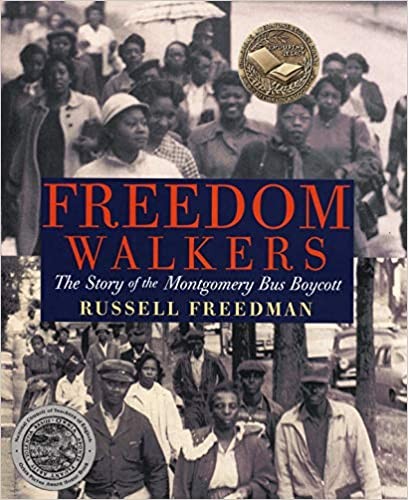
Freedom Walkers Comprehension Questions & Reading Journal
62 readers
Freedom Walkers has 9 chapters · 113 pages
Covers the events surrounding and including the Montgomery bus boycott, the end of segregation on buses.
Free, no sign-up. Customise to reword questions or add your reader’s name.
Inside the journal: 9 chapter pages, one question each · 3 example answers · a cover for your reader’s name
Chapter by chapter Each question is about its own chapter.
In Chapter 1, what bus rules made life unfair for Black riders in Montgomery, and how did those rules affect people’s everyday lives?See all 9 questions ↓
About the book
Covers the events surrounding and including the Montgomery bus boycott, the end of segregation on buses.
Buy the book on Amazon ↗ (affiliate link)
Freedom Walkers questions by chapter
We know this book well. Every question asks about something that happens in its chapter, a moment, a choice or a character, without giving away what comes next. One question per chapter, across all 9 chapters, and every one is editable before you print. The example answers under 3 of the chapters are the ones printed at the front of the booklet.
-
Chapter 1
In Chapter 1, what bus rules made life unfair for Black riders in Montgomery, and how did those rules affect people’s everyday lives?
-
Chapter 2
In Chapter 2, what do Rosa Parks’s actions show about her character? Use details from the chapter to explain your thinking.
Example answer: I think Rosa Parks’s actions show that she was brave and calm. She knew the bus rules were unfair, but she did not yell or fight. When she refused to give up her seat, she stood up for herself and for other Black people in Montgomery. Her choice helped many people decide it was time to work for change.
-
Chapter 3
In Chapter 3, the word “boycott” becomes very important. What does a boycott mean in this story, and why did people think it might help?
-
Chapter 4
In Chapter 4, after the first day of the bus boycott, what do you predict will happen next? What clues from the chapter support your prediction?
-
Chapter 5
In Chapter 5, how did leaders and everyday people work together to keep the boycott going?
Example answer: In my opinion, the boycott lasted because many people shared the work. Leaders helped plan meetings, give speeches, and organize rides. Everyday people walked long distances, drove others, and stayed away from the buses. This shows that a big change needed both strong leaders and regular people helping every day.
-
Chapter 6
In Chapter 6, what examples of courage do you notice, and why were those actions brave?
-
Chapter 7
In Chapter 7, what is your opinion of the ways people helped each other during the boycott, such as walking, sharing rides, or organizing carpools?
-
Chapter 8
In Chapter 8, how did the court case help the bus boycott, and why was the legal decision important?
-
Chapter 9
In Chapter 9, what is one big lesson or theme from the Montgomery Bus Boycott? How can that lesson still matter today?
Example answer: One big lesson is that people can make change when they work together and do not give up. The walkers had to be patient because the boycott lasted a long time. Today, this lesson still matters because people still need to speak up when something is unfair. The book shows me that peaceful action can be powerful.
More ready-made journals
-
 Farmer Boy
-
 Fever 1793
-
 Fight or Flight
-
 Fish In A Tree
-
 Five Little Peppers and How They Grew
-
 Flight of the sparrow
How to use this Freedom Walkers reading journal
At home, as a discussion guide
After each chapter your reader writes a few lines on that chapter’s question. Read the answer together at bedtime: it shows what they understood and gives you something real to talk about, without a quiz.
In class, as a novel study
Print a class set (booklets fold from plain letter paper) and use one question per chapter as the reading-response or literature-circle prompt. The example answers at the front show what a full answer looks like.
Homeschool
One booklet covers the whole book, 9 chapters, so it doubles as the reading log for Freedom Walkers. Reword any question before printing to match your reader.
Printing
The booklet PDF prints on ordinary 8.5 × 11 paper: print double-sided (flip on the short edge) at 100%, fold the stack in half and staple on the fold. There is also a one-page-per-sheet PDF and A5 binder pages.
Where the questions come from
Each question is about its own chapter. We know this book well. Every question asks about something that happens in its chapter, a moment, a choice or a character, without giving away what comes next. The questions were drafted with AI from what is known about the book and checked before publishing; every one is editable before you print.