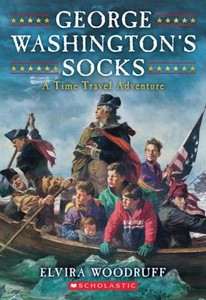
George Washington's socks Comprehension Questions & Reading Journal
4.2 out of 5, (5 ratings on Open Library)
George Washington's socks has 23 chapters · 166 pages
Free, no sign-up. Customise to reword questions or add your reader’s name.
Inside the journal: 23 chapter pages, one question each · 3 example answers · a cover for your reader’s name
Written for this book Questions about this story, good after any chapter.
What is the most important thing you have learned about Matt so far? Explain how a detail from your reading helped you understand him.See all 23 questions ↓
About the book
In the midst of a backyard campout, ten-year-old Matt and four other children find themselves transported back into the time of George Washington and the American Revolution, where they begin to live out American history firsthand and learn the sober realities of war.
Buy the book on Amazon ↗ (affiliate link)
George Washington's socks questions by chapter
We know the book, its characters, setting and story, but not what happens in each chapter. So every question is written for this book, and any of them works wherever your reader has just stopped. One question per chapter, across all 23 chapters, and every one is editable before you print. The example answers under 3 of the chapters are the ones printed at the front of the booklet.
-
Chapter 1
What is the most important thing you have learned about Matt so far? Explain how a detail from your reading helped you understand him.
-
Chapter 2
How would you describe the setting at this point in George Washington's Socks? Choose details that help you picture where the characters are.
-
Chapter 3
Which choice by Matt or Katie has caught your attention so far? Explain what the choice tells you about that character.
-
Chapter 4
What do you predict Matt might learn about George Washington or his time period? Use a clue from your reading to explain your prediction.
Example answer: I predict Matt will learn that people during the Revolutionary War faced problems he has never had to face. The story's connection to George Washington makes me think history will become more than facts to memorize. I think Matt may begin to understand how frightening that time could be. I will watch for details that show whether my prediction is right.
-
Chapter 5
How does Matt treat other people so far? Describe a moment that shows whether he is being thoughtful, impatient, helpful, or something else.
-
Chapter 6
What questions about the Revolutionary War has this story made you want to ask? Explain which part of your reading sparked your curiosity.
Example answer: I want to know what everyday life was like for young people during the Revolutionary War. Reading a story that connects Matt's adventure with that time makes me wonder how children experienced it. Did they understand why people were fighting, and how did they help their families? These questions remind me that history happened to ordinary people, too.
-
Chapter 7
Choose a word or phrase from your reading that helps describe a place in the story. What do you think it means, and how does it help you picture that place?
-
Chapter 8
Which part of Matt and Katie's story has seemed most surprising so far? Explain what you expected instead.
-
Chapter 9
What problem seems most important to the characters right now? Describe what makes it difficult to solve.
-
Chapter 10
How are Matt and Katie alike or different, based on what you have read? Use a detail about each character to support your answer.
-
Chapter 11
What might the characters do next to handle their current situation? Explain why your prediction fits what you know about them.
-
Chapter 12
Find a word in your reading that connects to adventure or history. Explain its meaning using clues from the story, and tell why it fits this book.
-
Chapter 13
Where have you noticed courage, or a need for courage, in the story so far? Explain why courage matters in that situation.
-
Chapter 14
How has the author made you curious about what will happen to Matt and the other characters? Describe a detail that keeps you reading.
-
Chapter 15
What does the story suggest so far about helping other people? Explain your thinking with an example from your reading.
-
Chapter 16
Which detail has helped you understand how Matt feels? Explain how his words, actions, or thoughts reveal that feeling.
-
Chapter 17
What kind of teammate would you want beside you on an adventure like Matt's? Connect your answer to a challenge or concern from the story so far.
Example answer: I would want a teammate who stays calm when we do not know what to do. Matt's adventure makes me think about how hard it would be to face an unfamiliar situation. A calm teammate could listen to everyone's ideas instead of rushing into a decision. I would also want someone who helps the whole group, not just themselves.
-
Chapter 18
How does the title, George Washington's Socks, connect to what you have read so far? If the connection is not clear yet, explain what the title makes you wonder.
-
Chapter 19
What have you learned—or begun to wonder—about life during the Revolutionary War? Explain how the story has shaped your thinking.
-
Chapter 20
Which character's point of view would you like to hear more about right now? Explain what that character might help you understand about the story.
-
Chapter 21
What lesson about responsibility might Matt or Katie be learning so far? Support your idea with something the character has said or done.
-
Chapter 22
Choose a sentence or short phrase that creates a strong feeling in your reading. Explain what its words mean and how they affect the mood.
-
Chapter 23
Looking back over your reading so far, how has your opinion of Matt changed or stayed the same? Explain which details have shaped your opinion.
Discussion questions for after George Washington's socks
Bigger questions for when the book is finished, each printed on its own ruled page at the end of the booklet.
- How does Matt change from the beginning of George Washington's Socks to the end? Explain what he learns about himself and other people, and use moments from different parts of the book to show what causes those changes.
- What do you think George Washington's Socks is really saying about courage, friendship, or the people who lived through the Revolutionary War? Choose one main message and explain how the characters and their experiences help you understand it. Include details from across the book and explain why that message matters to readers today.
More ready-made journals
-
 On my honor
-
 One Big Open Sky
-
 One for the Murphys
-
 Out of my mind
-
 Out of the Dust
-
 Owl Diaries Eva's Treetop Festival
How to use this George Washington's socks reading journal
At home, as a discussion guide
After each chapter your reader writes a few lines on that chapter’s question. Read the answer together at bedtime: it shows what they understood and gives you something real to talk about, without a quiz.
In class, as a novel study
Print a class set (booklets fold from plain letter paper) and use one question per chapter as the reading-response or literature-circle prompt. The example answers at the front show what a full answer looks like.
Homeschool
One booklet covers the whole book, 23 chapters, so it doubles as the reading log for George Washington's socks. Reword any question before printing to match your reader.
Printing
The booklet PDF prints on ordinary 8.5 × 11 paper: print double-sided (flip on the short edge) at 100%, fold the stack in half and staple on the fold. There is also a one-page-per-sheet PDF and A5 binder pages.
Where the questions come from
Questions about this story, good after any chapter. We know the book, its characters, setting and story, but not what happens in each chapter. So every question is written for this book, and any of them works wherever your reader has just stopped. The questions were drafted with AI from what is known about the book and checked before publishing; every one is editable before you print.