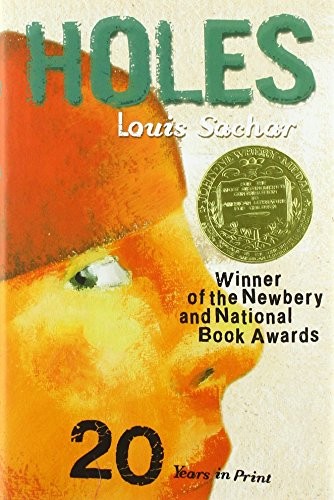
Holes Comprehension Questions & Reading Journal
4.3 out of 5, (199 ratings on Open Library)
Holes has 50 chapters · 240 pages
Stanley Yelnats is under a curse. A curse that began with his no-good-dirty-rotten-pig-stealing great-great-grandfather and has since followed generations of Yelnatses.
Free, no sign-up. Customise to reword questions or add your reader’s name.
Inside the journal: 50 chapter pages, one question each · 3 example answers · a cover for your reader’s name
Chapter by chapter Each question is about its own chapter.
How does the author describe Camp Green Lake, and what mood does this setting create for the story?See all 50 questions ↓
About the book
Stanley Yelnats is under a curse. A curse that began with his no-good-dirty-rotten-pig-stealing great-great-grandfather and has since followed generations of Yelnatses. Now Stanley has been unjustly sent to a boys' detention center, Camp Green Lake, where the boys build character by spending all day, every day, digging holes exactly five feet wide and five feet deep. There is no lake at Camp Green Lake. But there are an awful lot of holes.
Buy the book on Amazon ↗ (affiliate link)
Holes questions by chapter
We know this book well. Every question asks about something that happens in its chapter, a moment, a choice or a character, without giving away what comes next. One question per chapter, across all 50 chapters, and every one is editable before you print. The example answers under 3 of the chapters are the ones printed at the front of the booklet.
-
Chapter 1
How does the author describe Camp Green Lake, and what mood does this setting create for the story?
-
Chapter 2
Why do you think the boys at Camp Green Lake are made to dig holes every day? What might the adults believe digging will do?
-
Chapter 3
What do you learn about Stanley Yelnats and his family in this chapter? How does the family curse affect the way Stanley sees his life?
-
Chapter 4
How does Mr. Sir treat Stanley when he arrives at camp? What does this show you about life at Camp Green Lake?
-
Chapter 5
Stanley meets the boys in Tent D. Which boy stands out to you the most so far, and why?
-
Chapter 6
What really happened with the shoes that got Stanley in trouble? How does this event make you feel about Stanley’s punishment?
-
Chapter 7
How is digging Stanley’s first hole harder than he expected? What does this chapter show about Stanley’s character?
Example answer: Stanley’s first hole is much harder than he expected because the ground is hard, the shovel feels heavy, and the heat makes everything worse. He gets blisters and feels pain, but he keeps working until the hole is finished. This shows that Stanley is tougher than he thinks. Even though he is scared and tired, he does not give up.
-
Chapter 8
What makes the yellow-spotted lizards so dangerous? Why do you think the author gives them their own chapter?
-
Chapter 9
Stanley writes a letter home. Why does he leave out the hardest parts of camp, and what does this tell you about him?
-
Chapter 10
Stanley finds something in his hole. Why is he disappointed by the adults’ reaction to it?
-
Chapter 11
X-Ray asks Stanley to give him anything interesting he finds. What does this request show about power and friendship in the group?
-
Chapter 12
Mr. Pendanski talks to the boys about their futures. Do you think he is truly helping them? Explain your thinking.
-
Chapter 13
Stanley finds a gold tube with letters on it. What do you predict this object might mean later in the story?
-
Chapter 14
How does the Warden react when X-Ray shows her the gold tube? What does her reaction tell you about what the adults really want?
-
Chapter 15
The boys are ordered to dig in a special area. How does this change what you understand about the purpose of the holes?
-
Chapter 16
Stanley keeps trying to sound cheerful in his letters. Why might pretending things are okay be both kind and difficult?
-
Chapter 17
Zigzag hits Stanley with a shovel, but the adults do not seem very concerned. What does this show about safety and fairness at the camp?
-
Chapter 18
Zero asks Stanley to teach him to read. Why might Stanley say no at first, and what does this moment show about both boys?
-
Chapter 19
Stanley takes the blame for the stolen sunflower seeds. Was this a brave choice, a foolish choice, or both? Explain.
-
Chapter 20
How does the Warden use fear to control people in this chapter? Give an example from what she does or says.
-
Chapter 21
Stanley remembers the story of his great-grandfather and God’s Thumb. Why might this memory become important?
-
Chapter 22
Stanley and Zero make a deal to help each other. What does each boy gain from the deal besides the obvious help?
-
Chapter 23
How is Green Lake in the past different from Camp Green Lake in the present? What details help you picture it?
-
Chapter 24
Mr. Sir refuses to give Stanley water. How does this unfair treatment affect Stanley, and how might it affect the other boys watching?
-
Chapter 25
Describe the relationship between Miss Katherine and Sam. Why is their friendship important to the story?
-
Chapter 26
The town turns against Sam and Katherine. What does this chapter show about prejudice and injustice?
-
Chapter 27
How do Stanley and Zero’s reading lessons change their relationship? Use details from the chapter.
-
Chapter 28
Katherine Barlow becomes an outlaw. How do her painful experiences help explain, but not excuse, her choices?
-
Chapter 29
Stanley sees a mountain that looks like a thumb. What connections can you make between this sight and earlier stories in the book?
-
Chapter 30
Zero runs away after being insulted and mistreated. What feelings or events do you think pushed him to this point?
Example answer: I think Zero runs away because he has been treated like he does not matter for a long time. Mr. Pendanski’s cruel words probably make him feel angry and hopeless. Zero also sees that the adults are not really trying to help him. Running away is dangerous, but I can understand why he feels like he cannot stay anymore.
-
Chapter 31
How do the Warden and the counselors respond to Zero running away? What does their response reveal about them?
-
Chapter 32
Stanley decides to leave camp to look for Zero. What risks is he taking, and why might he think it is worth it?
-
Chapter 33
Stanley finds signs of danger in the desert. How does the author build suspense in this chapter?
-
Chapter 34
Stanley finds Zero under the old boat. What does this discovery make you wonder about the history of Camp Green Lake?
-
Chapter 35
Zero has survived by drinking “Sploosh.” What does this moment show about his strength and luck?
-
Chapter 36
Stanley and Zero head toward the mountain. How do they depend on each other during this difficult journey?
-
Chapter 37
The boys struggle with thirst and exhaustion. What words or details help you understand how serious their situation is?
-
Chapter 38
Stanley carries Zero up the mountain. What does this action reveal about Stanley’s growth as a person?
-
Chapter 39
Stanley sings a song to Zero and notices important family connections. How does this chapter connect the past and present?
-
Chapter 40
The boys find onions and water on the mountain. Why does this discovery feel like more than just good luck?
-
Chapter 41
Zero explains how he got Clyde Livingston’s shoes. How does this change your understanding of Stanley’s arrest?
-
Chapter 42
Stanley and Zero make a plan to return to camp. Do you think their plan is wise, dangerous, or both? Explain.
-
Chapter 43
As Stanley and Zero sneak back, what clues remind readers that the camp still holds secrets?
-
Chapter 44
Stanley and Zero dig up a suitcase. What do you predict is inside, and why might it matter?
-
Chapter 45
The yellow-spotted lizards crawl on Stanley and Zero. Why is this one of the most suspenseful moments in the book?
-
Chapter 46
Stanley and Zero stay still through the night. What inner strengths do they need to survive this scene?
-
Chapter 47
The suitcase has Stanley’s name on it. How does this detail change the power between Stanley, Zero, and the Warden?
-
Chapter 48
Stanley refuses to leave without Zero. What does this choice show about his friendship and sense of justice?
-
Chapter 49
Many problems are solved in this chapter. Which solution feels the most satisfying to you, and why?
-
Chapter 50
Looking back at the whole book, what message do you think Louis Sachar wants readers to understand about fate, friendship, or justice?
Example answer: I think Louis Sachar wants readers to see that friendship can help people change their lives. Stanley and Zero both suffer unfairly, but they become stronger when they help each other. The ending also shows that wrong actions from the past can still affect people later. To me, the book says that justice may take a long time, but kindness and courage matter.
More by Louis Sachar
All 4 →
More ready-made journals
How to use this Holes reading journal
At home, as a discussion guide
After each chapter your reader writes a few lines on that chapter’s question. Read the answer together at bedtime: it shows what they understood and gives you something real to talk about, without a quiz.
In class, as a novel study
Print a class set (booklets fold from plain letter paper) and use one question per chapter as the reading-response or literature-circle prompt. The example answers at the front show what a full answer looks like.
Homeschool
One booklet covers the whole book, 50 chapters, so it doubles as the reading log for Holes. Reword any question before printing to match your reader.
Printing
The booklet PDF prints on ordinary 8.5 × 11 paper: print double-sided (flip on the short edge) at 100%, fold the stack in half and staple on the fold. There is also a one-page-per-sheet PDF and A5 binder pages.
Where the questions come from
Each question is about its own chapter. We know this book well. Every question asks about something that happens in its chapter, a moment, a choice or a character, without giving away what comes next. The questions were drafted with AI from what is known about the book and checked before publishing; every one is editable before you print.
Browse: All books by Louis Sachar