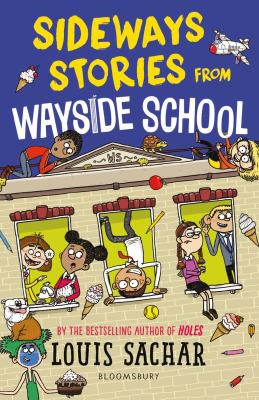
Sideways Stories from Wayside School Comprehension Questions & Reading Journal
4.0 out of 5, (27 ratings on Open Library)
Sideways Stories from Wayside School has 30 chapters · 128 pages
Book 1 of the Wayside School series
Free, no sign-up. Customise to reword questions or add your reader’s name.
Inside the journal: 30 chapter pages, one question each · 3 example answers · a cover for your reader’s name
Chapter by chapter Each question is about its own chapter.
How does Mrs. Gorf use her power over the students, and why do the children finally decide they must stop her?See all 30 questions ↓
About the book
Presents humorous episodes from the classroom on the thirtieth floor of Wayside School, which was accidentally built sideways with one classroom on each story.
Buy the book on Amazon ↗ (affiliate link)
Sideways Stories from Wayside School questions by chapter
We know this book well. Every question asks about something that happens in its chapter, a moment, a choice or a character, without giving away what comes next. One question per chapter, across all 30 chapters, and every one is editable before you print. The example answers under 3 of the chapters are the ones printed at the front of the booklet.
-
Chapter 1
How does Mrs. Gorf use her power over the students, and why do the children finally decide they must stop her?
-
Chapter 2
On Mrs. Jewls's first day in the class on the thirtieth floor, what does she misunderstand about the students, and how does that make the chapter funny?
-
Chapter 3
What does Mrs. Jewls discover about Joe's counting, and how is his way of thinking different from what she expects?
-
Chapter 4
Why is Sharie's sleeping in class such a problem, and what does the chapter show about the unusual rules of Wayside School?
-
Chapter 5
Todd tries to behave, but he keeps getting sent home early. What makes his situation unfair, and how does he react to it?
Example answer: I think Todd's situation is unfair because he is trying to be good, but he still gets blamed and sent home early. It seems like once the teacher expects him to get in trouble, it is hard for him to prove he is behaving. I would feel frustrated if people did not notice my effort. Todd's chapter shows that being judged too quickly can hurt someone.
-
Chapter 6
Bebe can draw very quickly. What lesson does Mrs. Jewls try to teach her about doing work well instead of just doing a lot of it?
-
Chapter 7
Calvin is asked to take a note to Miss Zarves. How does this errand become confusing, and what does it show about the strange building?
-
Chapter 8
Myron becomes class president. What does he learn about leadership and responsibility after he gets the job?
-
Chapter 9
Maurecia loves ice cream, but the special ice cream in this chapter causes a surprise. What does the surprise reveal about Maurecia and Todd?
-
Chapter 10
Paul keeps wanting to pull Leslie's pigtails. Why is it hard for him to stop, and what helps him learn his lesson?
-
Chapter 11
Dana is bothered by mosquito bites during class. How does she try to deal with the problem, and what makes the situation silly?
-
Chapter 12
Jason has a sticky problem with gum. What different ways do people try to help him, and which part seems the most ridiculous?
-
Chapter 13
Rondi has strong feelings about her missing front teeth. How do other people's reactions to her smile affect the way she feels?
-
Chapter 14
Sammy seems like a new student at first. What clues make the class suspicious, and how does the truth about Sammy change the mood of the chapter?
-
Chapter 15
Deedee wants to play with a certain ball at recess. How does she try to get what she wants, and what does the chapter suggest about fairness?
-
Chapter 16
D.J. is cheerful for no clear reason. How do the other characters respond to his happiness, and what do you think the chapter says about joy?
-
Chapter 17
John reads differently from everyone else. How does Mrs. Jewls help him, and what does this show about accepting unusual learners?
-
Chapter 18
Leslie has an unusual problem involving her toes. How does the chapter change the way she thinks about something she usually takes for granted?
-
Chapter 19
The chapter about Miss Zarves is very unusual. How does the missing nineteenth story make the joke work, and why might the author include a chapter like this?
Example answer: The joke works because the school has no nineteenth story, so Miss Zarves should not exist either. The chapter feels like it is about something that is not really there, which matches the silly logic of Wayside School. I think Louis Sachar includes it to surprise the reader and make us laugh. It also reminds me that this book does not follow normal school rules.
-
Chapter 20
Kathy is often mean and unhappy with others. How do her thoughts and actions affect her friendships in the class?
-
Chapter 21
Ron struggles during a playground game. How do his classmates respond, and what does his experience show about encouragement?
-
Chapter 22
The three Erics each have the same first name but different personalities. How do names and nicknames cause confusion or unfairness in this chapter?
Example answer: The three Erics are confusing because they share a name, but they are not the same person at all. Their nicknames can feel unfair when the name does not match who they really are. This made me think that people should not be judged only by a label. A name can be funny in the story, but it can also affect how others see you.
-
Chapter 23
Allison ends up in a classroom where she does not seem to belong. How does she figure out something is wrong, and what does she do about it?
-
Chapter 24
Dameon spends a lot of time running between Mrs. Jewls and Louis. How does his helpfulness become both important and frustrating?
-
Chapter 25
Jenny is late to school because of odd delays and surprises. Which part of her journey seems the strangest, and how does it fit the humor of Wayside School?
-
Chapter 26
Terrence often causes trouble on the playground. How do his choices affect the other children, and what consequence does he face?
-
Chapter 27
Joy takes lunches that do not belong to her. What does her behavior show about selfishness, and how do the others respond?
-
Chapter 28
Nancy is upset because people tease him about his name. How does this chapter make you think about names, identity, and treating people with respect?
-
Chapter 29
Stephen stands out from the rest of the class in his chapter. How do the reactions of other people make his situation funnier or more embarrassing?
-
Chapter 30
Louis, the yard teacher, is important to the students. How does the final chapter show his connection to the class and bring the book to a satisfying end?
Next in Wayside School
All 2 →
More by Louis Sachar
All 4 →

More ready-made journals
-
 New Kid
-
 Night of the Ninjas
-
 No Place on Earth
-
 Nothing but the Truth
-
 Number the Stars
-
 Of Mice and Men
How to use this Sideways Stories from Wayside School reading journal
At home, as a discussion guide
After each chapter your reader writes a few lines on that chapter’s question. Read the answer together at bedtime: it shows what they understood and gives you something real to talk about, without a quiz.
In class, as a novel study
Print a class set (booklets fold from plain letter paper) and use one question per chapter as the reading-response or literature-circle prompt. The example answers at the front show what a full answer looks like.
Homeschool
One booklet covers the whole book, 30 chapters, so it doubles as the reading log for Sideways Stories from Wayside School. Reword any question before printing to match your reader.
Printing
The booklet PDF prints on ordinary 8.5 × 11 paper: print double-sided (flip on the short edge) at 100%, fold the stack in half and staple on the fold. There is also a one-page-per-sheet PDF and A5 binder pages.
Where the questions come from
Each question is about its own chapter. We know this book well. Every question asks about something that happens in its chapter, a moment, a choice or a character, without giving away what comes next. The questions were drafted with AI from what is known about the book and checked before publishing; every one is editable before you print.
Browse: All books by Louis Sachar