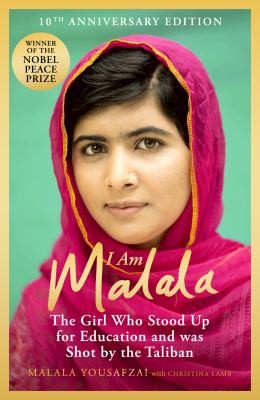
I am Malala Comprehension Questions & Reading Journal
4.3 out of 5, (38 ratings on Open Library)
I am Malala has 24 chapters · 336 pages
Free, no sign-up. Customise to reword questions or add your reader’s name.
Inside the journal: 24 chapter pages, one question each · 3 example answers · a cover for your reader’s name
Written for this book Questions about this story, good after any chapter.
What have you learned so far about why going to school matters to Malala? Explain using a detail from your reading.See all 24 questions ↓
About the book
When the Taliban took control of the Swat Valley in Pakistan, one girl spoke out. Malala Yousafzai refused to be silenced and fought for her right to an education. On Tuesday, October 9, 2012, when she was fifteen, she almost paid the ultimate price. She was shot in the head at point-blank range while riding the bus home from school, and few expected her to survive.
Buy the book on Amazon ↗ (affiliate link)
I am Malala questions by chapter
We know the book, its characters, setting and story, but not what happens in each chapter. So every question is written for this book, and any of them works wherever your reader has just stopped. One question per chapter, across all 24 chapters, and every one is editable before you print. The example answers under 3 of the chapters are the ones printed at the front of the booklet.
-
Chapter 1
What have you learned so far about why going to school matters to Malala? Explain using a detail from your reading.
-
Chapter 2
How does Malala’s father, Ziauddin, show what he believes about education in the pages you have read?
-
Chapter 3
Which detail about Malala’s home in Pakistan’s Swat Valley helps you picture her world? Explain why that detail stands out.
-
Chapter 4
Based on your reading so far, do you think girls and boys have the same chances to learn in Malala’s world? Explain what seems fair or unfair.
Example answer: I do not think girls and boys always have the same chances to learn in Malala’s world. Malala explains that girls are not always valued in the same way as boys. Her father supports her learning, but not every girl has that support. I think this is unfair because being a girl should not decide whether someone can go to school.
-
Chapter 5
What do you predict Malala will do next to work toward a hope she has shared? Use something you have already read as a clue.
-
Chapter 6
Choose a word connected to school or learning from your reading. What do you think it means, and how does it help you understand Malala’s experience?
-
Chapter 7
Where in your reading so far does Malala seem brave, worried, or both? Explain what her feelings help you understand about her.
-
Chapter 8
What have you learned about Malala’s family life? Describe a family detail that helps you understand her better.
-
Chapter 9
What does Malala’s story suggest so far about why a young person’s voice matters? Support your idea with a detail from the book.
Example answer: I think Malala’s story shows that young people have important ideas about their own lives. She explains why school matters to her instead of letting adults tell her whole story. Her love of learning helps me understand what children could lose when they cannot attend school. I believe listening to children can help adults make fairer choices.
-
Chapter 10
Which choice by Malala or someone in her family do you most admire so far? Explain why you admire it.
-
Chapter 11
Who in Malala’s life might help her face her next challenge? Make a prediction based on what that person has already said or done.
-
Chapter 12
Find a word or phrase that describes a place in Malala’s world. How do the nearby sentences help you figure out its meaning?
-
Chapter 13
What lesson about fairness can you find in the pages you have read? Explain how Malala’s experiences help show that lesson.
-
Chapter 14
Which belief seems especially important to Malala so far? Describe how her words or actions reveal that belief.
-
Chapter 15
How does a school connect people in Malala’s community, based on what you have read? Give an example of that connection.
-
Chapter 16
What part of Malala’s life feels familiar to you, even if your home is very different from hers? Explain the connection.
-
Chapter 17
Which problem from your reading do you think could become harder for Malala or her family? Explain the clues behind your prediction.
-
Chapter 18
Select an unfamiliar word from Malala’s account of her life in Pakistan. What might it mean, and which clues helped you make that guess?
-
Chapter 19
How do Malala’s own wishes connect with what her family wants for her? Describe a way those wishes match or differ in your reading so far.
-
Chapter 20
What detail about daily life in Pakistan has taught you something new? Explain what you learned without assuming that everyone in Pakistan lives the same way.
-
Chapter 21
In what way are Malala and her father alike, and in what way do they seem different so far? Use details from the book.
Example answer: I notice that Malala and her father both care deeply about education. Her father runs a school, and Malala loves being a student. They are different because he sees school as a parent and teacher, while she sees it as a child who wants to learn. I think their different experiences help them understand why education matters.
-
Chapter 22
If you could ask Malala one question about something you have already read, what would you ask? Explain why her answer would matter to you.
-
Chapter 23
How might a small action in the pages you have read make a difference to Malala, her family, or her community?
-
Chapter 24
Choose one important event from your reading so far. How would you explain what happened and why it matters to someone who has never heard of Malala?
Discussion questions for after I am Malala
Bigger questions for when the book is finished, each printed on its own ruled page at the end of the booklet.
- How does Malala grow or change throughout the book, and which beliefs stay strong? Use details from different parts of her story to explain what shapes her.
- What do you think I am Malala is really teaching readers about education, family, and courage? Explain how these ideas connect, using examples from the whole book, and describe which message matters most to you.
More by Malala Yousafzai
All 2 →
More ready-made journals
-
 Mary Anne Saves the Day
-
 Masterminds
-
 Matilda
-
 Mercy Watson
-
 Midnight at the Mansion
-
 Midnight on the Moon
How to use this I am Malala reading journal
At home, as a discussion guide
After each chapter your reader writes a few lines on that chapter’s question. Read the answer together at bedtime: it shows what they understood and gives you something real to talk about, without a quiz.
In class, as a novel study
Print a class set (booklets fold from plain letter paper) and use one question per chapter as the reading-response or literature-circle prompt. The example answers at the front show what a full answer looks like.
Homeschool
One booklet covers the whole book, 24 chapters, so it doubles as the reading log for I am Malala. Reword any question before printing to match your reader.
Printing
The booklet PDF prints on ordinary 8.5 × 11 paper: print double-sided (flip on the short edge) at 100%, fold the stack in half and staple on the fold. There is also a one-page-per-sheet PDF and A5 binder pages.
Where the questions come from
Questions about this story, good after any chapter. We know the book, its characters, setting and story, but not what happens in each chapter. So every question is written for this book, and any of them works wherever your reader has just stopped. The questions were drafted with AI from what is known about the book and checked before publishing; every one is editable before you print.
Browse: All books by Malala Yousafzai