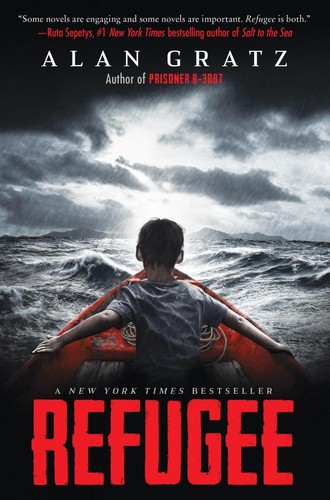
Refugee Comprehension Questions & Reading Journal
4.1 out of 5, (36 ratings on Open Library)
Refugee has 53 chapters · 352 pages
Free, no sign-up. Customise to reword questions or add your reader’s name.
Inside the journal: 53 chapter pages, one question each · 3 example answers · a cover for your reader’s name
Chapter by chapter Each question is about its own chapter.
When the Nazis break into Josef's home, how does Josef's life change in just one night? Use details from the chapter to explain your thinking.See all 53 questions ↓
A printable reading journal for Refugee: one question per chapter, with example answers.
Buy the book on Amazon ↗ (affiliate link)
Refugee questions by chapter
We know this book well. Every question asks about something that happens in its chapter, a moment, a choice or a character, without giving away what comes next. One question per chapter, across all 53 chapters, and every one is editable before you print. The example answers under 3 of the chapters are the ones printed at the front of the booklet.
-
Chapter 1
When the Nazis break into Josef's home, how does Josef's life change in just one night? Use details from the chapter to explain your thinking.
-
Chapter 2
Why does Isabel's family begin thinking about leaving Cuba? What risks do they know they might face?
-
Chapter 3
How does the bombing in Aleppo change Mahmoud's idea of what home means? What details show how dangerous his life has become?
Example answer: I think the bombing shows Mahmoud that home is not really safe anymore. A home is supposed to be a place where you can relax with your family, but his apartment and neighborhood are full of danger. I noticed that his family has to make fast choices just to survive. This made me understand why leaving home can be scary but also necessary.
-
Chapter 4
On Josef's journey to the ship, how do fear and hope both show up in his family? What does Josef notice about the adults around him?
-
Chapter 5
What do Isabel's actions while getting ready to leave show about her personality? How is she helpful to her family?
-
Chapter 6
Why is it hard for Mahmoud's family to decide to leave Syria? What would you have felt if you were in his place?
-
Chapter 7
When Josef first gets on the ship, what makes it seem safer than life in Germany? What hints show that danger may still be ahead?
-
Chapter 8
How does the ocean become a problem for Isabel and the others on the boat? Describe how the setting creates tension.
-
Chapter 9
Mahmoud's family has to trust people they do not know. How can trust be helpful and dangerous on their journey?
-
Chapter 10
What does Josef learn about fairness and unfairness while he is on the ship? Give an example from the chapter.
-
Chapter 11
How does music connect Isabel to her family and to Cuba? Why do you think music matters so much to her?
-
Chapter 12
Mahmoud tries to stay calm and solve problems during the trip. What is one example of his resourcefulness?
-
Chapter 13
How has Josef's father changed after being imprisoned? How does this change the way Josef sees his role in the family?
-
Chapter 14
What choice does Isabel make when the boat is in trouble? What does this show about her courage?
-
Chapter 15
How do Mahmoud and his family react when the sea journey becomes dangerous? What do their reactions teach you about them?
-
Chapter 16
Josef is growing up quickly because of the danger around him. What responsibilities does he take on in this chapter?
-
Chapter 17
How do the people on Isabel's boat work together to survive? What does teamwork look like in this chapter?
-
Chapter 18
Mahmoud faces a heartbreaking situation on the water. How does this moment show the cost of being a refugee?
-
Chapter 19
When the ship reaches Cuba, why do the passengers feel both excited and worried? What do they hope will happen?
-
Chapter 20
What new dangers or surprises does Isabel face on the way to Florida? How does she keep going?
-
Chapter 21
Mahmoud thinks about being invisible and being seen. What do you think he means by that, and why does it matter?
-
Chapter 22
How do the children on Josef's ship try to act normal? Why might normal moments be important during frightening times?
-
Chapter 23
What does Isabel learn about fear from the adults around her? How does she respond to that fear?
-
Chapter 24
Mahmoud's family meets police, crowds, or borders on their journey. How do these obstacles make the trip harder?
-
Chapter 25
What does the refusal to let many passengers enter Cuba show about prejudice and power? How does Josef respond?
-
Chapter 26
How does Isabel's family handle a crisis on the boat? What does this show about love and sacrifice?
-
Chapter 27
Mahmoud has to decide whether to stay quiet or speak up. What choice does he make, and what are the possible results?
-
Chapter 28
Josef's father makes a dangerous decision. How does this event affect Josef and the rest of his family?
-
Chapter 29
How does Lito's story connect Isabel's journey to Josef's journey? Why is this connection important?
Example answer: I think Lito's story is important because it shows that refugees have been treated unfairly in different times and places. Isabel is trying to reach safety, just like Josef and the people on the ship long ago. The connection helped me see that history can repeat if people do not learn from it. It also made the book feel like one big story instead of three separate stories.
-
Chapter 30
What does Mahmoud learn about crowds of refugees in this chapter? How can a crowd give people both safety and danger?
-
Chapter 31
Josef and the other passengers must face a new disappointment. How do people react when their hopes are taken away?
-
Chapter 32
Isabel experiences a painful loss. How does the group keep moving even while they are grieving?
-
Chapter 33
Mahmoud's family keeps traveling even when they are tired and scared. What helps them persevere?
-
Chapter 34
How does Josef's family try to rebuild their lives after leaving the ship? What problems still follow them?
-
Chapter 35
How does Isabel change after losing someone she cares about? What does she learn about being strong?
-
Chapter 36
In Mahmoud's journey, strangers sometimes help refugees. What act of kindness stands out, and why does it matter?
-
Chapter 37
Josef's family finds some safety, but it may not last. How does the author show that danger is still close?
-
Chapter 38
Isabel is close to reaching Florida. Why can being almost safe still feel frightening?
-
Chapter 39
What hopes does Mahmoud have when his family gets closer to Germany? What worries might still be with him?
-
Chapter 40
How does Josef show bravery when the Nazis return to threaten his family? What would you want readers to remember about him?
-
Chapter 41
Isabel and her family must make another difficult choice near the end of their trip. How does this choice show sacrifice?
-
Chapter 42
Mahmoud finally reaches a place that may be safe. How does safety feel different after everything he has been through?
-
Chapter 43
Josef faces an impossible choice to protect people he loves. What does this chapter show about family and courage?
-
Chapter 44
What does reaching land mean for Isabel? How can this moment be both happy and sad?
-
Chapter 45
Mahmoud meets people in Germany who connect to the past. How does this meeting help connect the three stories?
-
Chapter 46
What do Josef's final actions teach you about sacrifice? How did your feelings about Josef change by this point?
-
Chapter 47
Isabel starts a new life in Miami. What might be exciting for her, and what might still be hard?
-
Chapter 48
How does Mahmoud react to being welcomed after so much rejection? What does welcome mean in this chapter?
-
Chapter 49
How does learning more about Josef's family help you understand the long-lasting effects of war and hate?
-
Chapter 50
Isabel returns to music in her new home. How can music help her remember the past and also move forward?
-
Chapter 51
Mahmoud learns that stories from the past are connected to his own story. Why is it important to remember refugee stories?
-
Chapter 52
How does Isabel's ending show both hope and loss? What do you think her future might be like?
-
Chapter 53
What message do all three endings leave about refugees, courage, and kindness? Use examples from more than one character's story.
Example answer: I think the endings show that refugees are brave people who want safety for their families. Josef's story showed sacrifice, and Isabel's story showed how hard it can be to start over in a new place. Mahmoud's story showed that kindness from strangers can make a big difference. The book made me think people should welcome refugees instead of judging them.
More by Alan Gratz
All 5 →



More ready-made journals
-
 Sarah, plain and tall
-
 Save Me a Seat
-
 Saving Winslow
-
 Scare Bear
-
 Scarlet Morning
-
 School according to Humphrey
How to use this Refugee reading journal
At home, as a discussion guide
After each chapter your reader writes a few lines on that chapter’s question. Read the answer together at bedtime: it shows what they understood and gives you something real to talk about, without a quiz.
In class, as a novel study
Print a class set (booklets fold from plain letter paper) and use one question per chapter as the reading-response or literature-circle prompt. The example answers at the front show what a full answer looks like.
Homeschool
One booklet covers the whole book, 53 chapters, so it doubles as the reading log for Refugee. Reword any question before printing to match your reader.
Printing
The booklet PDF prints on ordinary 8.5 × 11 paper: print double-sided (flip on the short edge) at 100%, fold the stack in half and staple on the fold. There is also a one-page-per-sheet PDF and A5 binder pages.
Where the questions come from
Each question is about its own chapter. We know this book well. Every question asks about something that happens in its chapter, a moment, a choice or a character, without giving away what comes next. The questions were drafted with AI from what is known about the book and checked before publishing; every one is editable before you print.
Browse: All books by Alan Gratz