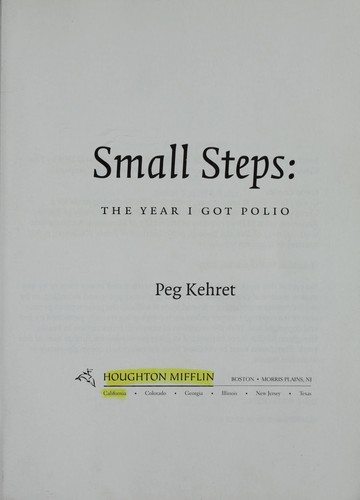
Small steps : the year I got polio Comprehension Questions & Reading Journal
Small steps : the year I got polio has 20 chapters · 179 pages
Free, no sign-up. Customise to reword questions or add your reader’s name.
Inside the journal: 20 chapter pages, one question each · 3 example answers · a cover for your reader’s name
Chapter by chapter Each question is about its own chapter.
What do you learn about Peg's ordinary life before she gets very sick, and why is that important to the story?See all 20 questions ↓
A printable reading journal for Small steps : the year I got polio: one question per chapter, with example answers.
Buy the book on Amazon ↗ (affiliate link)
Small steps : the year I got polio questions by chapter
We know this book well. Every question asks about something that happens in its chapter, a moment, a choice or a character, without giving away what comes next. One question per chapter, across all 20 chapters, and every one is editable before you print. The example answers under 3 of the chapters are the ones printed at the front of the booklet.
-
Chapter 1
What do you learn about Peg's ordinary life before she gets very sick, and why is that important to the story?
-
Chapter 2
How do Peg's first symptoms change the mood of the story, and what clues show that her illness may be serious?
-
Chapter 3
How does Peg react when she learns more about what is happening to her body, and what would you have wondered if you were in her place?
-
Chapter 4
What is Peg's first impression of the hospital or ward, and how does the setting affect her feelings?
Example answer: Peg's first impression is that the hospital feels strange, serious, and a little frightening. She is away from her family and surrounded by sick children and medical routines she does not understand yet. I think the setting makes her feel lonely and worried because she cannot just go home when she wants to. At the same time, it helps the reader understand how brave she has to be.
-
Chapter 5
Choose one new or important word from this chapter, such as a medical word. What does it mean, and how does knowing it help you understand the chapter?
-
Chapter 6
How do the treatments Peg receives challenge her, and what do they show about her courage?
-
Chapter 7
How do Peg's relationships with other patients help her handle being away from home?
-
Chapter 8
Which adult in this chapter makes a difference for Peg, and what actions show that person's character?
-
Chapter 9
What does Peg learn about polio or recovery in this chapter, and how does that knowledge affect her attitude?
-
Chapter 10
Peg's progress is not always easy or fast. What is one small success or setback in this chapter, and why does it matter?
-
Chapter 11
What prediction can you make about Peg's recovery after the events in this chapter? Use details from the chapter to support your prediction.
-
Chapter 12
How does Peg show determination during therapy or exercises, even when things are painful or frustrating?
Example answer: Peg shows determination by keeping on trying even when her body does not do what she wants it to do. She has to work hard at exercises that may seem small to other people, but they are huge for her. I think she feels frustrated sometimes, but she does not give up. Her effort shows that courage can mean practicing again and again.
-
Chapter 13
How does Peg deal with homesickness or missing her family, and what does this reveal about her personality?
-
Chapter 14
What problem does Peg face as she tries to become more independent, and how does she work toward solving it?
-
Chapter 15
How does Peg's idea of a normal life change during this chapter?
-
Chapter 16
What sad, scary, or surprising event happens in this chapter, and how does Peg respond to it?
-
Chapter 17
How does coming home or thinking about home bring both happiness and new challenges for Peg?
-
Chapter 18
What does this chapter show about the importance of patience when someone is healing?
-
Chapter 19
The title Small Steps has a special meaning. How does this chapter connect to that theme?
Example answer: This chapter connects to the title because Peg's recovery happens little by little instead of all at once. Each small improvement, like moving better or doing something more independently, is important. I think the title reminds readers that big goals can be reached through many small steps. Peg's story shows that even tiny progress can be worth celebrating.
-
Chapter 20
After finishing the book, what lesson do you think Peg Kehret wants readers to remember, and why?
More by Peg Kehret
All 2 →
More ready-made journals
-
 Hurricane Heist
-
 I am Malala
-
 I Am Malala [Young Readers adaptation]
-
 I Am Rebel
-
 I Know Why the Caged Bird Sings
-
 I Survived
How to use this Small steps : the year I got polio reading journal
At home, as a discussion guide
After each chapter your reader writes a few lines on that chapter’s question. Read the answer together at bedtime: it shows what they understood and gives you something real to talk about, without a quiz.
In class, as a novel study
Print a class set (booklets fold from plain letter paper) and use one question per chapter as the reading-response or literature-circle prompt. The example answers at the front show what a full answer looks like.
Homeschool
One booklet covers the whole book, 20 chapters, so it doubles as the reading log for Small steps : the year I got polio. Reword any question before printing to match your reader.
Printing
The booklet PDF prints on ordinary 8.5 × 11 paper: print double-sided (flip on the short edge) at 100%, fold the stack in half and staple on the fold. There is also a one-page-per-sheet PDF and A5 binder pages.
Where the questions come from
Each question is about its own chapter. We know this book well. Every question asks about something that happens in its chapter, a moment, a choice or a character, without giving away what comes next. The questions were drafted with AI from what is known about the book and checked before publishing; every one is editable before you print.
Browse: All books by Peg Kehret